We believe that taking accountability for our planet requires more than just building vehicles with zero tailpipe emission. It means reshaping how the entire automotive industry measures, proves, and advocates for environmental impact. While the transition to electric mobility is accelerating, the sustainability space has long been hindered by a lack of standardized data, leaving room for misinformation, hidden assumptions and greenwashing.
Rivian is actively stepping up to change the status quo by championing industry-wide standards, publishing rigorous Life Cycle Assessments (LCAs), and supporting climate advocacy with peer-reviewed science.
Driving Industry Alignment | SAE J3341™
Automotive LCAs have historically functioned as black boxes. Using the exact same vehicle data, different experts could end up with divergent carbon footprint calculations. This lack of standard reporting guardrails made true apples-to-apples comparisons across manufacturers almost impossible.
To solve this, Rivian’s Product Sustainability team led the SAE International Task Force to establish SAE J3341™: Carbon Footprint Methodologies for Light-Duty Vehicles. Published by SAE International, J3341™ creates a universal reference for the entire automotive sector:
The true impact of SAE J3341™ depends on widespread adoption. Rivian will append the Disclosure Addendum to our upcoming vehicle footprint reports (starting with our R2 platform) as we advocate for clear, comparable data across mobility.
Leading with Transparency | Our Portfolio of Carbon Reports
Accountability starts with showing our work. Since releasing our initial footprint reports in 2024, Rivian has consistently measured, updated, and published the full lifecycle carbon footprint of our entire lineup.
Our public LCA portfolio tracks our progress as our technology and manufacturing evolve:
With every report, we raise the bar for ourselves and our peers. On September 22, we published the first official carbon footprint report for R2, marking the next chapter in our decarbonization journey.
Grounding the Debate in Science | Peer-Reviewed Research
Scientific clarity is essential when incomplete data or bad-faith arguments stall climate progress. To address claims about EV manufacturing footprints head-on, Rivian partnered with University of California, Davis to publish a comprehensive lifecycle analysis in Nature’s Communications Sustainability: "Electrifying light vehicles in the United States shows emission reduction potential for all vehicle types and powertrains."Opens in new tab
By analyzing every model year 2023 light vehicle in the U.S., the study proved that battery electric vehicles reduce lifetime emissions across all modeled scenarios, regardless of local grid mix, climate, or battery longevity.
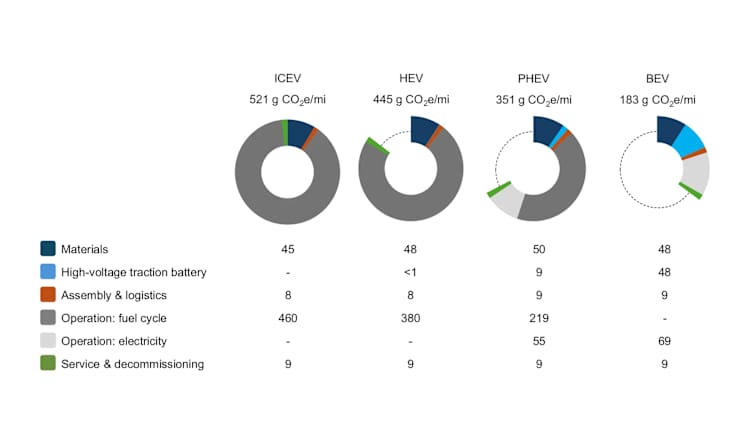
The significance of our research was reinforced in a recent study published in Science, "The climate benefits of retiring a fully operational internal combustion engine vehicle." Opens in new tabTesting whether scrapping a working gas car early yields a net climate benefit, the authors evaluated their findings against our dataset. Our aligned results helped confirm that EV climate savings stem from the inherent efficiency of electric drivetrains rather than specific modeling choices.