Rivian’s inaugural Autonomy & AI Day offered attendees a look at how our vertically-integrated approach and dedicated engineering teams are building the AI and autonomy platforms that will define the next generation of driving.
Watch the full presentation hereOpens in new tab and read on for highlights below.
Opening remarks from Rivian CEO and Founder RJ Scaringe
Rivian’s vertical integration strategy uniquely positions the company to lead the charge into an AI-defined future.
We’re doing this in three distinct and cost-effective ways:
Investing in the hardware and compute infrastructure, powering innovation and providing headroom for enhanced capabilities and extensible use cases.
Developing an advanced, self-improving, end-to-end AI system for our autonomy platform that scales.
Harnessing a shared data foundation across the business that enables us to transform the ownership experience, service and manufacturing.
Electrical Hardware
SVP of Electrical Hardware Vidya Rajagopalan detailed how Rivian is taking a massive leap forward in developing advanced autonomy and physical AI with the introduction of our third generation compute platform.
At launch, our third generation autonomy hardware will have a leading combination of vehicle sensors and inference available in North America.
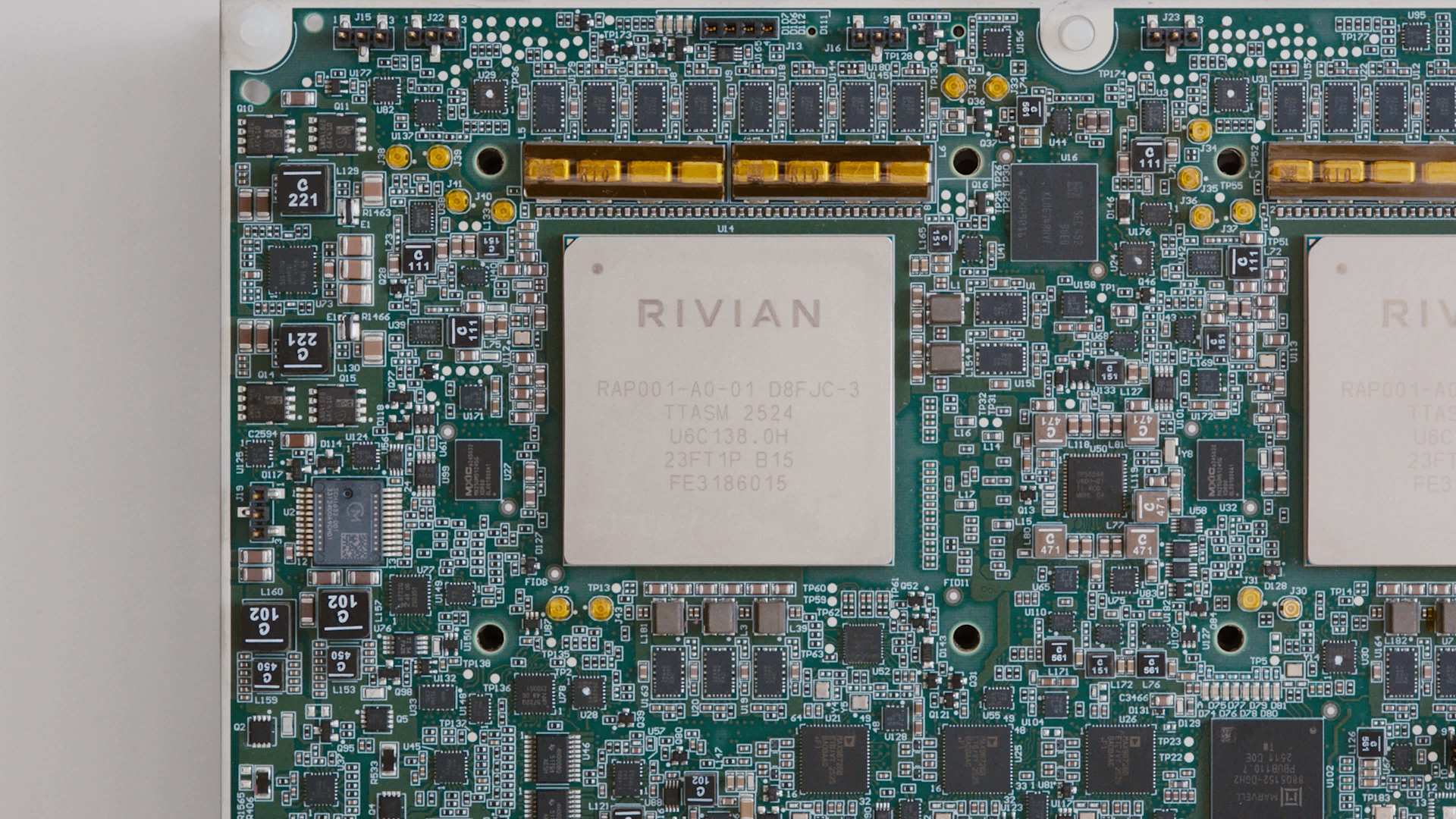
Rivian’s third generation compute module, Gen 3 Autonomy Computer, achieves 1600 sparse INT8 TOPS (trillion operations per second). To illustrate the sheer speed, Gen 3 Autonomy Computer can process 5 billion pixels per second.
At the heart of Gen 3 Autonomy Computer is the Rivian Autonomy Processor (RAP1), our proprietary, purpose-built silicon. RAP1 is among the first multi-chip modules used in high compute applications within the automotive industry.
Rivian’s in-house neural net engine (NNE) runs directly on the chip.
RAP1 is optimized for interfacing with many different sensor modalities to do inference processing with deterministic latencies—an important requirement for Physical AI.
RivLink is RAP1’s high-speed interconnect that connects multiple chips to multiply processing power across a distributed system.
Engineered for functional safety, RAP1 includes multiple layers of protection with rigorous ASIL (automotive safety integrity level) designation.
Together, Rivian’s next generation of in-house autonomy hardware exemplifies the benefits of a vertically-integrated system that gives our engineering teams more velocity than ever before, higher performance and power, and meaningful cost savings.


Doubling down on multi-modal and expanding to LiDAR
Our multi-modal sensor system, including cameras and radars, provides rich data to perception, feeding early fusion.
Building on this foundation, we will integrate LiDAR into our fleet, starting with future R2 models. LiDAR provides detailed, three-dimensional spatial data and redundant sensing —this helps make our R2 fleet a very large ground truth fleet for training our model.
Autonomy
VP of Autonomy and AI James Philbin shared more about the future of Rivian Autonomy Platform, our engine for advanced and trusted autonomy capabilities.
Trained end-to-end, built in-house, infinitely scalable
Rivian Autonomy Platform begins with a self-improving data flywheel that’s designed to learn about human driving—especially the unpredictable nuances. Pre-tagged instances are transmitted to the Rivian Cloud, where the high-fidelity data sets are automatically organized and labeled. With near real-time capability, it is a pipeline that operates with extreme speed fleet-wide, every minute of every day, and builds an ever-expanding knowledge base.
This knowledge base fuels the Large Driving Model (LDM), Rivian’s foundational self-driving model. Its LLM-like architecture enables us to apply advances in generative AI directly to our autonomy stack, including reinforcement learning which distills superior driving strategies to the on-board models with minimal compute overhead.
LDM is improving capabilities on Gen 2 vehicles now and will see even more advancement in future vehicles with Gen 3 Autonomy Computer.
With this system in place, the whole stack is always improving with every release, and we have a feature roadmap that stretches to the highest levels of autonomy.
Advances coming to Gen 2 and beyond
Building on LDM and our robust data foundation, an upcoming software update will include Universal Hands-Free. This new capability brings hands-free driving to over 3.5 million miles of roads in the US and Canada, covering the vast majority of marked roads in the US.
Rivian Autonomy+, our autonomy subscription for Rivian’s continuously expanding capabilities, is launching in early 2026 and priced at $2,500 (one-time) or $49.99 (per month).
Vehicle Software
Chief Software Officer Wassym Bensaid outlined how our vertically integrated, modular software platform is AI-ready by design, and how we’re using AI to evolve the in-vehicle and customer experience.
From software-defined to AI-defined architecture
Rivian Unified Intelligence (RUI) is our shared, multi-modal data foundation across the business, helping us develop powerful new features, improve our service infrastructure, and even predict maintenance needs before they become an issue.
Rivian’s in-house agentic framework enables the assistant to effortlessly work with third-party apps, like your calendar.
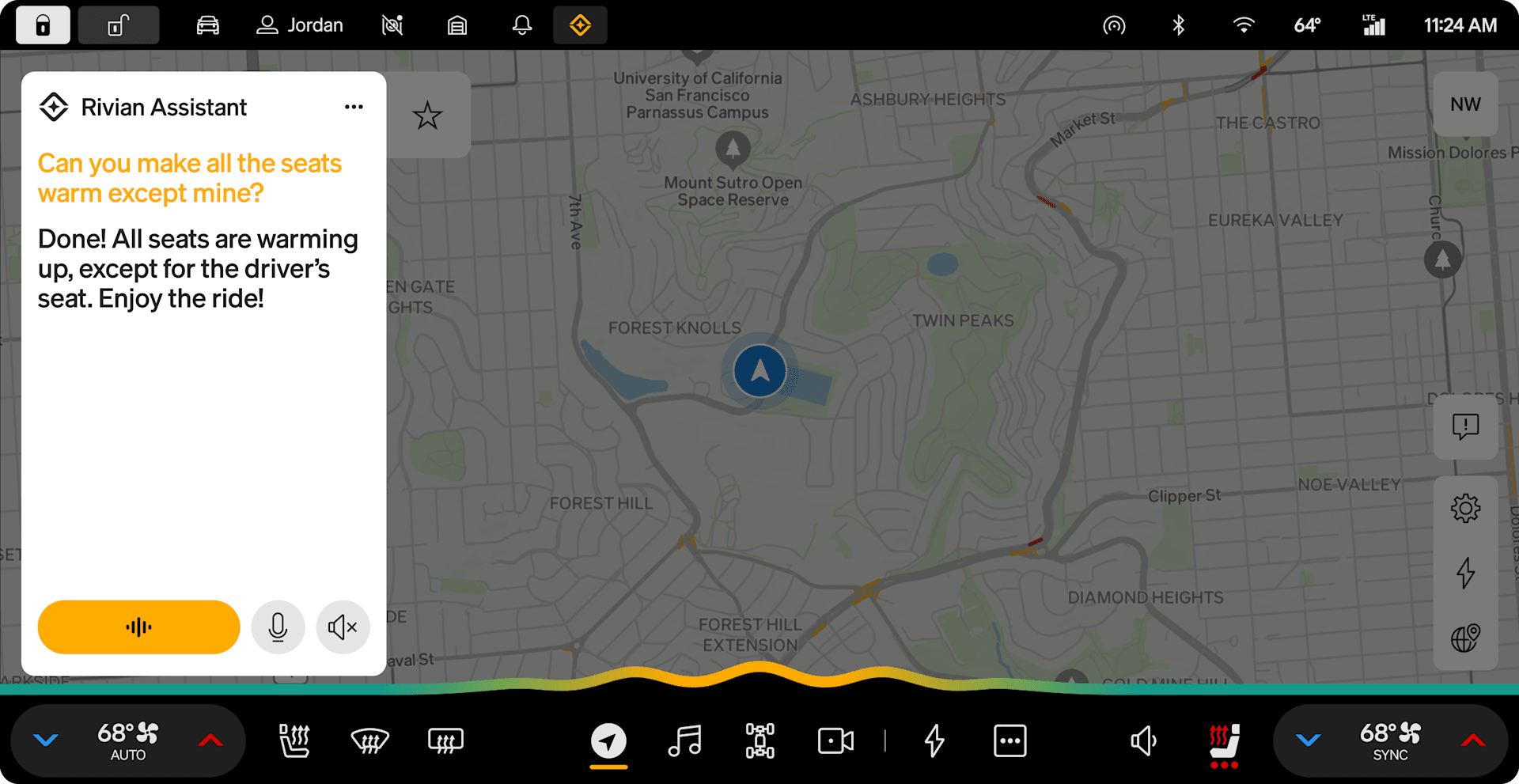
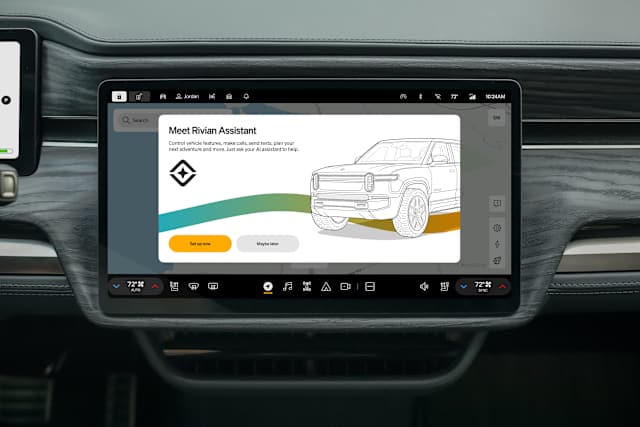
Rivian Assistant is built on this intelligence. It is your new voice-activated companion that helps you control your vehicle, ask about your day, send messages and more entirely hands-free. It uses RUI and edge models to understand your vehicle, your digital life and the world around you.
Our assistant leverages frontier large language models help ensure your conversations are natural, providing accurate information and powerful reasoning.
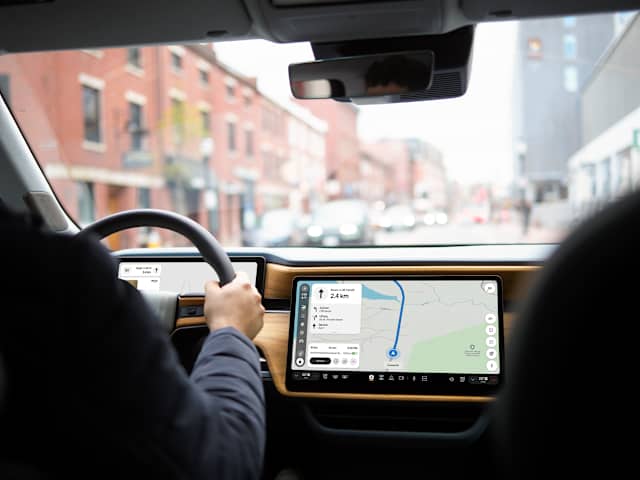
Rivian’s in-house agentic framework enables the assistant to effortlessly work with third-party apps, like your calendar. Ask about your day, navigate to your next appointment, or even reschedule a meeting while you drive.
At launch, R2 will have a powerful infotainment computer that will enable the Rivian Assistant to run entirely offline, achieving higher performance and lower latency.
Step changes to service
RUI will fundamentally change service by embedding AI into diagnostics. It’s an expert assistant for technicians, scanning telemetry and history to pinpoint complex issues. This same advanced intelligence will soon power Rivian’s mobile app, improving self-service diagnostics.
The future of transportation will be defined by AI, and Rivian is dedicated to building products that define our leadership in the category.
Going further, our vertically-integrated strategy and teams enable us to create foundational technologies that will help move the industry forward.