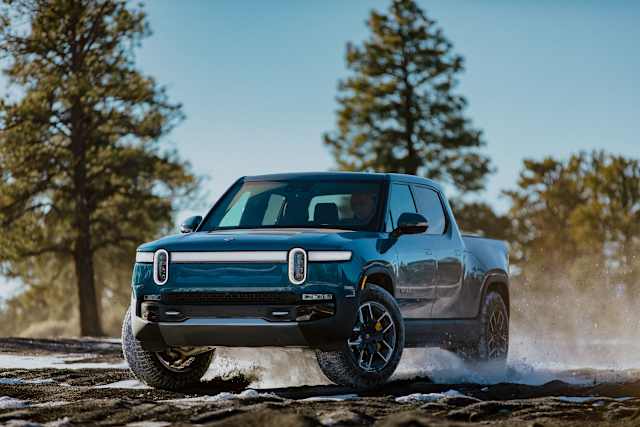
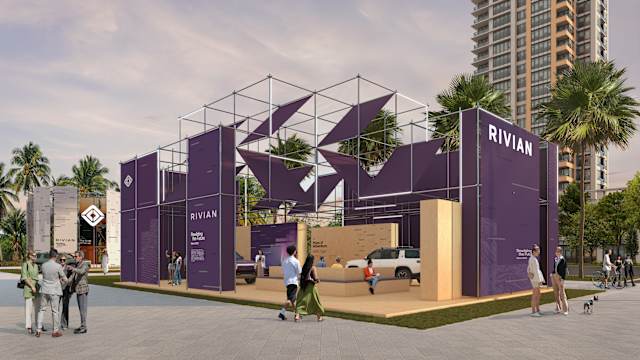
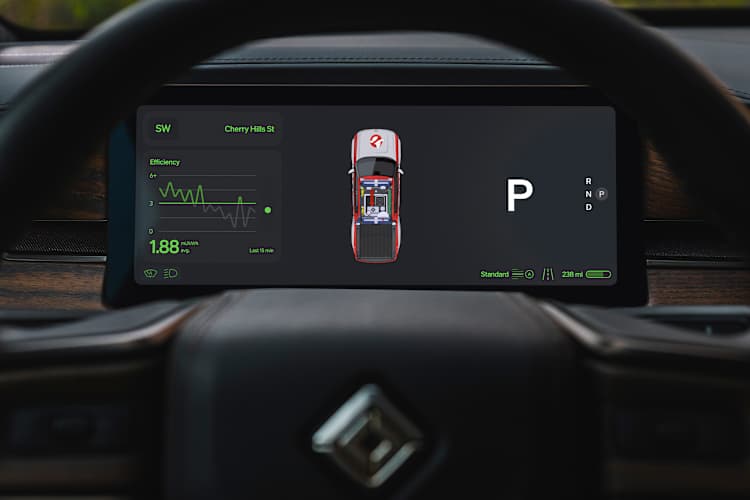
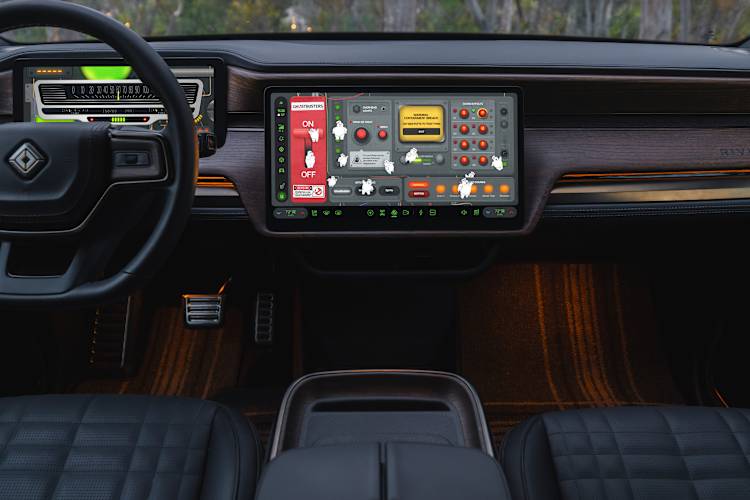
Halloween ModeOpens in new tab is possible because of Rivian's vertically integrated hardware and software. Since we design and engineer everything in-house, we can enhance practically every aspect of your vehicle. And since it's a connected car, in a single over-the-air update, your vehicle can transform in seconds, even into an Ecto-R1 or Ecto-R2.
How Does an OTA Update Work?
Just like updating an app on your smartphone, we deliver new software to your Rivian. Most times it takes a few minutes and can be completed overnight while your vehicle is parked in the driveway. OTAs have brought everything from steering-control refinements, entirely new drive modes, Rivian Assistant, Kick Turn, and yes even the recently launched Ghostbusters car costume for Halloween 2026—to your Rivian.
“Halloween Mode demonstrates the power of Rivian software. New features and drive modes arrive overnight, right in your driveway… with a little extra spooky fun added in.”
What Happens When You Engage Something Like Halloween Mode?
Engaging Halloween Mode is as simple as pressing a button. Behind the scenes, it’s a lot more complex. Here’s what happens in a matter of seconds:
You make a selection Tap the Ghostbusters icon on the center screen (or ask Rivian Assistant to do it for you), or select the Trick or Treat card in your mobile app.
The instruction goes onto the vehicle’s network The infotainment computer sends it across a high-speed ethernet backbone that connects your vehicle’s three zonal controllers.
Each controller does its part Our system is designed as one integrated system, so the lights, speakers, and displays each get their cue at the same moment, enabling more immersive experiences.
Lights, sound and screens respond together Let the fun begin.
The Halloween software arrived with the 2026.36 update on Oct. 7. At 4 a.m. local time on Oct. 9, we switched Halloween Mode on across the entire fleet, the mobile app, the watch app, and Rivian Adventure Network chargers, without sending a new update to any vehicle. On Nov. 2, it turns itself off the same way.
What’s a Zonal Controller?
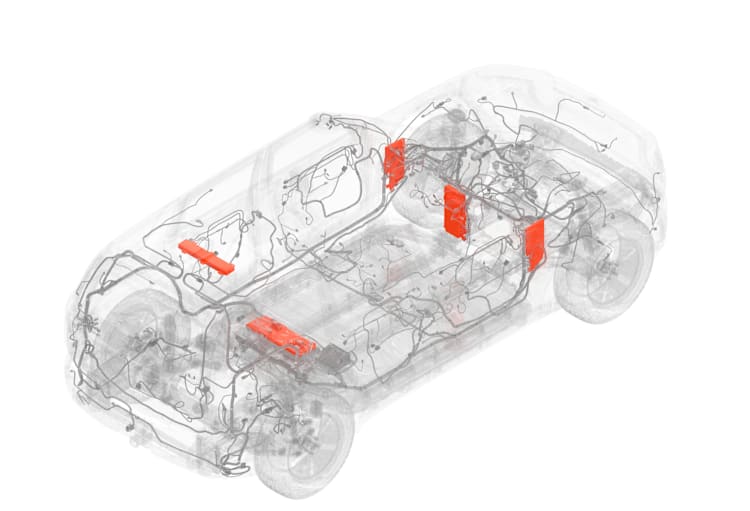
Think of a Rivian as a network, not a collection of parts. Instead of dozens of separate electronic control units (ECUs), each tied to an isolated function (and many times created by an outside supplier), we use three zonal controllers that we designed ourselves. Each one manages the hardware in its part of the vehicle, with Rivian software controlling all complex behavior logic.
Those controllers talk to each other, and to the infotainment computer behind your driver display, over a high-speed ethernet backbone. So when you tap “Trick or Treat,” the instruction reaches the exterior lights, the audio system, and the displays across the vehicle at nearly the same moment.
R2 uses the same ECU layout introduced on R1 Gen 2, yet takes the simplification further with 2.3 miles less wiring and 60% fewer in-line connectors than Gen 2, which was itself a major reduction in complexity from Gen 1.
Why does that matter? Less wiring and fewer connectors mean less weight, less cost, a simpler assembly line, and fewer places for something to go wrong. It also means fewer computers to coordinate, which is the foundation for everything that follows: updates that reach every Rivian, and features that adapt to each vehicle’s hardware.
Why Owning the Stack Matters
In many vehicles, key controllers arrive from outside suppliers as sealed units. The code inside belongs to the supplier, and so does the timeline for changing it. A feature that touches the lights, the audio and the displays can mean coordinating across several companies, multiple layers down, each with its own roadmap.
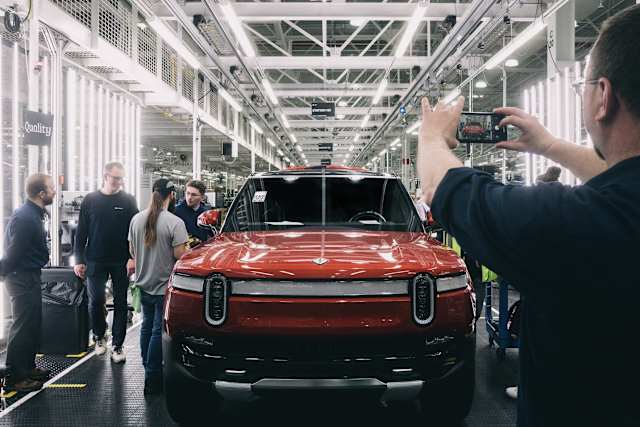
Rivian took a different approach. We started with clean-sheet software, so there’s no legacy code to unwind, and we write the software that runs on our controllers. Owning the stack means owning the software that decides how every component behaves and operates within the vehicle.
That shows up in three ways: Coordinated experiences The lights, audio and displays run on one software stack we control, so a single tap can transform all of them together. That same control lets us give hardware a second job: exterior lights become a light show, speakers become a haunted soundtrack, and even Gear Guard gets in on the fun. Halloween Mode is the most visible example, and any new feature works the same way.
One operating system for every generation R1 Gen 1, R1 Gen 2 and R2 all run RivianOS 2, so a feature built once can reach every Rivian that can physically support it.
Delivering on customer expectations As a result of our fast feedback loop, we can iterate and address customer needs directly without waiting on outside suppliers. And because we own both the hardware and the software, we can act quickly and ship features in the next OTA update instead of waiting for a typical model-year refresh.
Three Generations, Single OS
RivianOS 2 brought R1 Gen 1 (model year 2022–2024), R1 Gen 2 (model year 2025–present) and R2 onto a single operating system and unified stack. It was our most wide-ranging OTA update, bringing a reimagined interface, route alerts and dynamic controls to all three. More importantly, it changed what an update means. With one operating system across the lineup, every OTA arrives on every Rivian, tailored to what each vehicle’s hardware can do.
The new Ghostbusters lock sounds show exactly how that works. R1 Gen 1 gets the Ecto-1 sound. R1 Gen 2 and R2 add Proton Pack and Chant. It’s the same update and the same software approach, adapted to what each vehicle can do.
“Because we own the software on our controllers, we can design a feature across lights, audio and displays as one thing instead of three negotiations, and deliver it to every generation of Rivian in the same update.”
Built to Scale
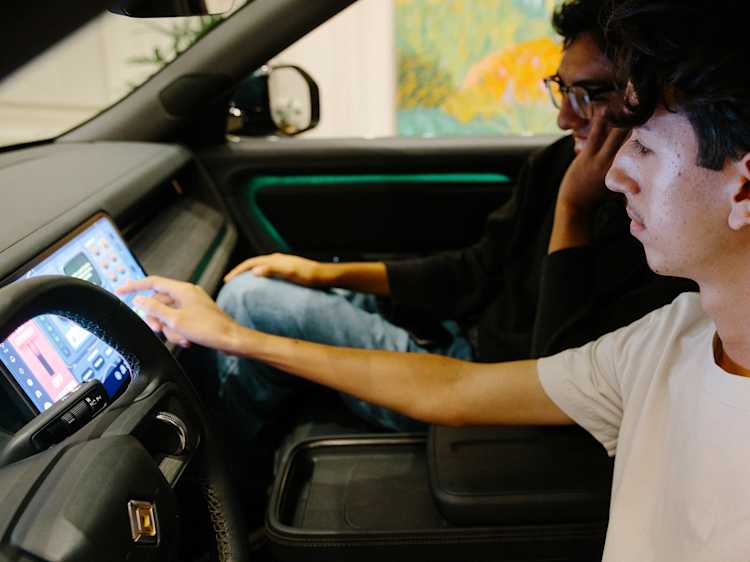
Rivian has delivered near-monthly software updates to the fleet over the past three years, bringing new drive modes, autonomy upgrades and UX enhancements, as well as AI-powered tools like Rivian Assistant and more.
“When you own the whole platform, every new idea, from a Halloween costume, to unique drive modes, to the next big feature, everything gets built once and runs everywhere possible,” said Wassym Bensaid, Chief Software Officer for Rivian and Co-CEO of Rivian Volkswagen Group Technologies. “We built this stack to scale well beyond Rivian. Halloween Mode is just our fun way to prove the power of this vertically integrated approach.”
For owners, that means a Rivian that keeps improving long after you buy it. And for any new vehicles developed off this software stack, it means they start from a mature, proven system running on the road today, instead of starting from scratch across many disconnected vehicle platforms.
That’s the real trick behind the treat.