Story by Jennifer Warnick
The first time I heard of the Rebelle RallyOpens in new tab was in a phone interview for my job at Rivian. I learned that just a few months earlier, in October 2020, a pre-production model of a Rivian R1T had become the first fully electric truck to ever compete in — and finish — the week-long, off-road, navigation rally.
The moment I hung up, I fell into a deep, internet rabbit hole that led to a short film about Rivian’s rally debut.Opens in new tab I watched as veteran driver Emme Hall and navigator Rebecca Donaghe rolled over dunes and down backcountry roads in a sleek-but-tough looking electric truck and was delighted to learn that the longest road rally in the United States, “just happens to be for women,” as Rebecca said.
The rally features 60 vehicles, each piloted by a team of two adventurous women who, between them, possess the skills and gumption needed to cross 1,500 miles of desert wilderness with no roads and no technology. Rebelle teams mainly use the analog tools of early explorers to find their way – compasses, plotters, rolls of maps and sheer determination.
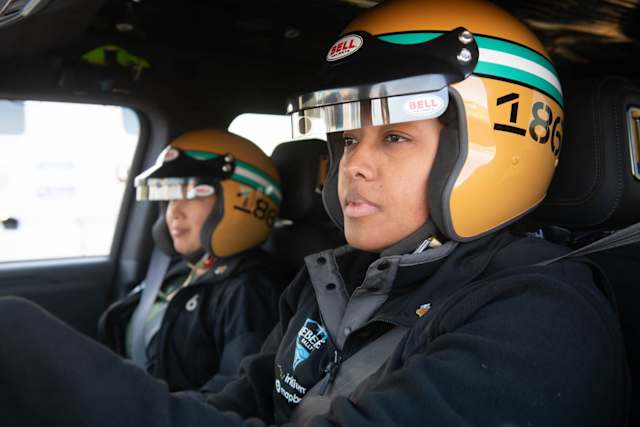
The uncharted adventure. The unforgiving wilderness. The camaraderie. It all looked so exciting – even the mandatory helmets. Two things became abundantly clear after watching the film. First: I really wanted this job. How cool would it be to work for a company capable not only of producing a rally-capable electric vehicle, but also one willing to toss the proverbial keys to Emme and Rebecca and tell them to go for it? Second: I really wanted to be a part of the Rebelle Rally.
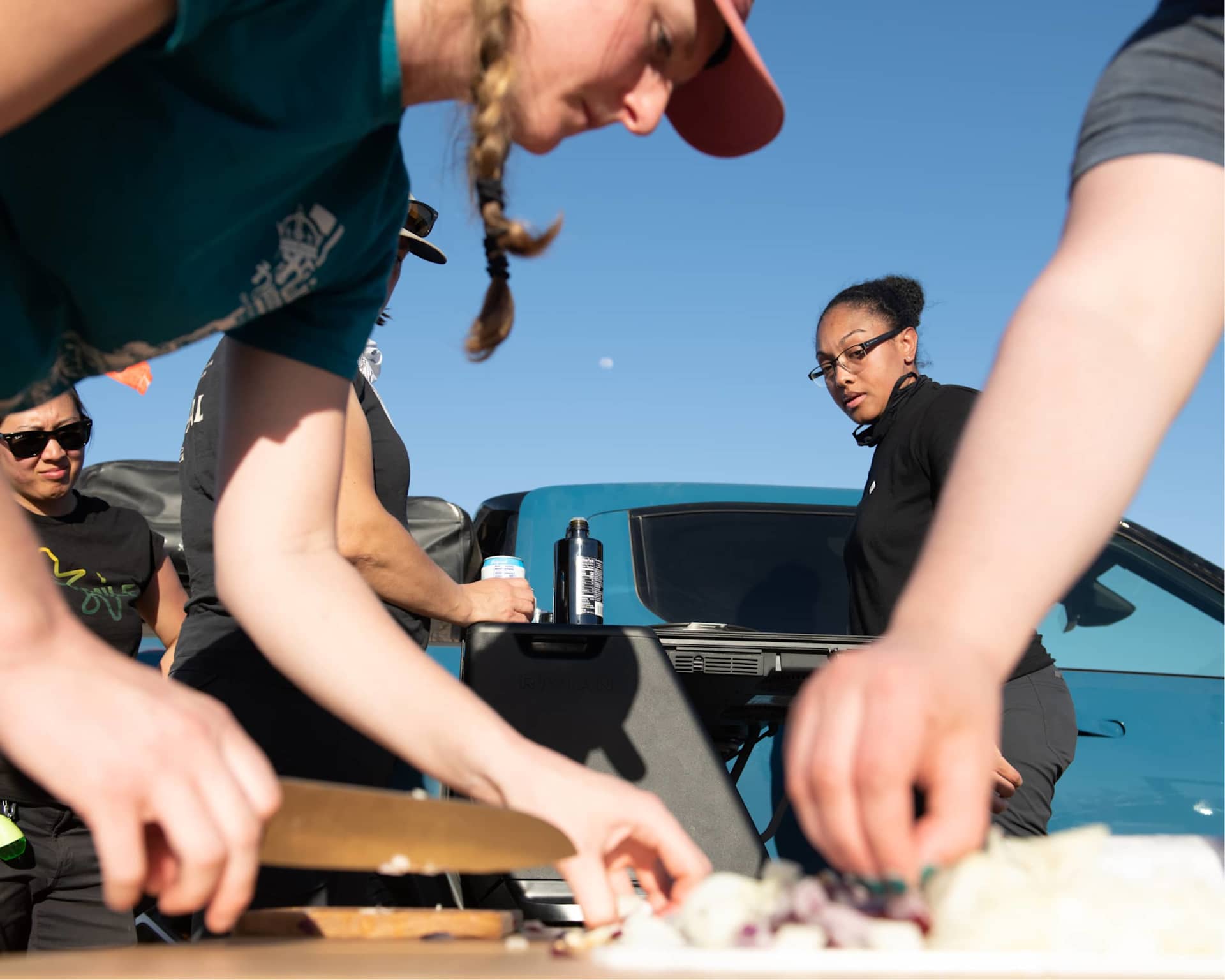
Some fast forwarding here: I got the job. Emme and Rebecca competed in the 2021 rally, once again in an R1T. But early this year, the dynamic duo decided to take a break from the 2022 rally. When the news spread a small group of enthusiasts – myself included – began to wonder. What if a team of Rivian employees competed in the Rebelle? This idea was met by unequivocal support and enthusiasm from our leaders and teams. So in early 2022, a small but intrepid group of women from across Rivian began to learn together.
Above all, the Rebelle Rally demands next-level skillsOpens in new tab in map and compass navigation. But it also requires precision off-road driving, wilderness recovery skills and careful vehicle maintenance and care, not to mention plenty of desert and backcountry savvy.
It was clear at our first meetup that we’d all be bringing unique superpowers to this endeavor. For my part, I was one of two from the creative side of Rivian now embedded with a group of the most technically and mechanically gifted women I’d ever met. Where I might have been intimidated by their encyclopedic knowledge of our vehicles and ability to fix just about anything, I was struck by their kindness and generosity. No matter what skills we brought with us, we were in this together.
Could we, in a few short months, pick up the wide range of skills it takes to drive and navigate off-road in the competition with confidence, skill, and panache – but no technology?
We were about to find out.
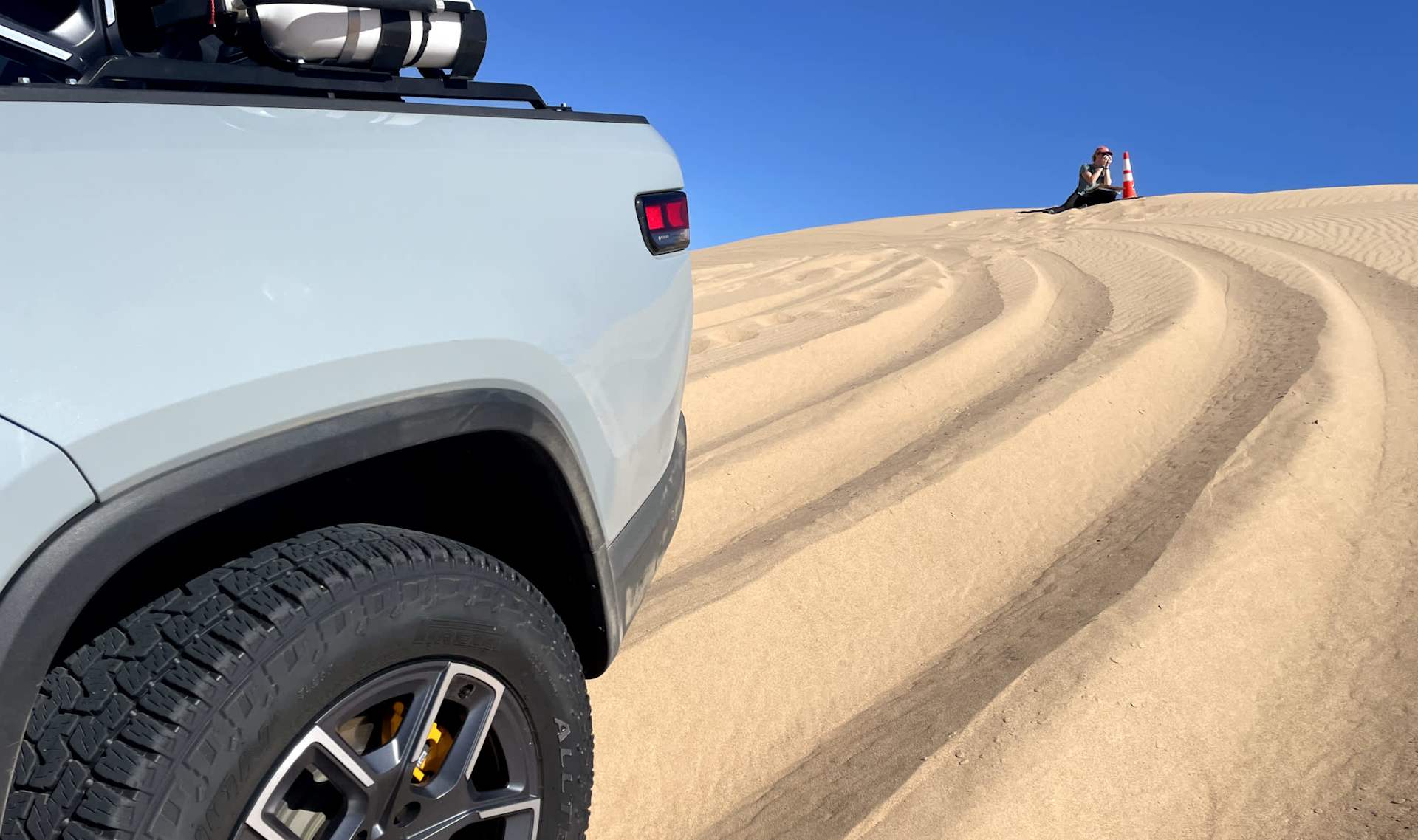
Imperial Sand Dunes, California
To Dune or Not to Dune
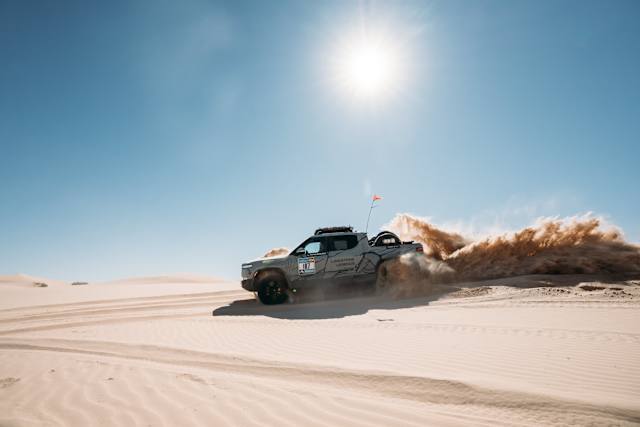
Algodones. Imperial. Glamis. There are a lot of names to describe the largest sand dune ecosystem in the United States, the 45-mile stretch of sand mountains surrounding us on all sides, but only one word for our current situation: stuck.
Nicole Johnson, director of human machine interface (HMI) at Rivian, sighs and puts the truck in park. She picks up the radio. “Green hornet, looks like we may be digging again. We’re getting out to have a look,” she calls to the R1T zipping around one dune over.
The radio crackles. “Roger that, Enterprise, heading your way,” replies Rosanna “Ro” Nuch, a senior service lab technician.
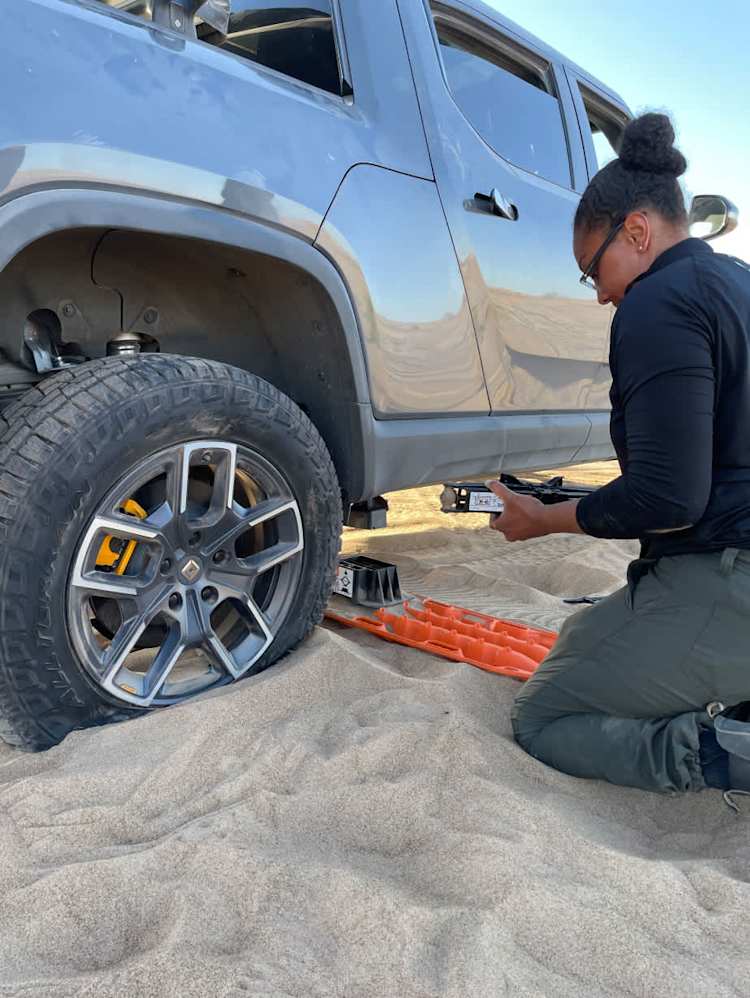
Nicole and I look down at our tires, which are nearly covered by sand, and then at each other.
“I’ll get the shovel,” she said.
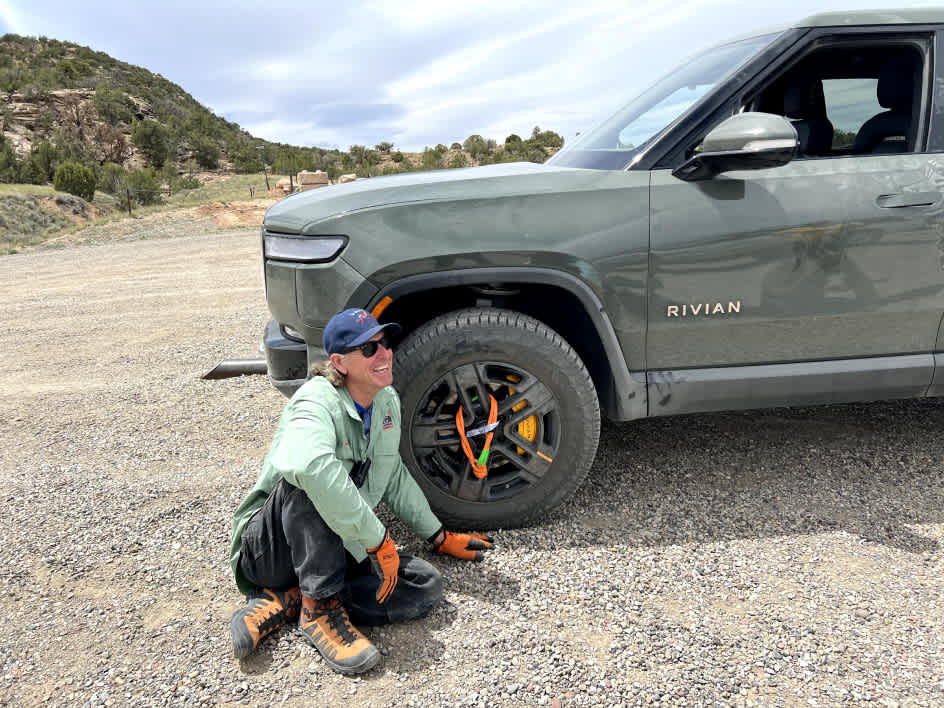
“I’m on MAXTRAX,” I replied, opening the Gear Tunnel and pulling out a stack of bright orange traction recovery boards to place under each tire to help pop us out of the sand pit.
These dunes are where the eight-day Rebelle Rally ends, but where many competitors-in-training return early and often because of the unique treachery they pose. The final checkpoints of the rally will lie in and around this mammoth sea of sand, and for competitors close in points heading into the last hours of the rally, being able to drive the soft sand dunes and navigate with a near total absence of landmarks can make or break a rally win.
For most competitors, it’s not a question of whether they’ll get stuck, but when. Then it’s about how quickly they can get themselves free. The Glamis dunes are the literal and figurative deep end of the Rebelle Rally, so of course it’s where we started.
It’s March, still months to go before the rally in October, but our small crew is coming together quickly. None of us have competed in Rebelle before but most have had some sort of involvement. Elyse McArthur, a field engineer, worked the start line at the 2021 rally, and Nicole and Ro worked as mechanics helping to repair competitor vehicles (when they weren’t all sheltering from sandstorms). Lilly Macaruso, a senior special project engineer, actually used to work for the Rebelle Rally. The rest of us are rally newbies.
We are camping in the desert with a couple of dozen other women for a rally skills class put on by Nena Barlow, an off-road master trainer and winner of the 2021 Rebelle Rally. We are learning by doing – navigation, a little bit of rock crawling, driving on sand, and extracting stuck vehicles.
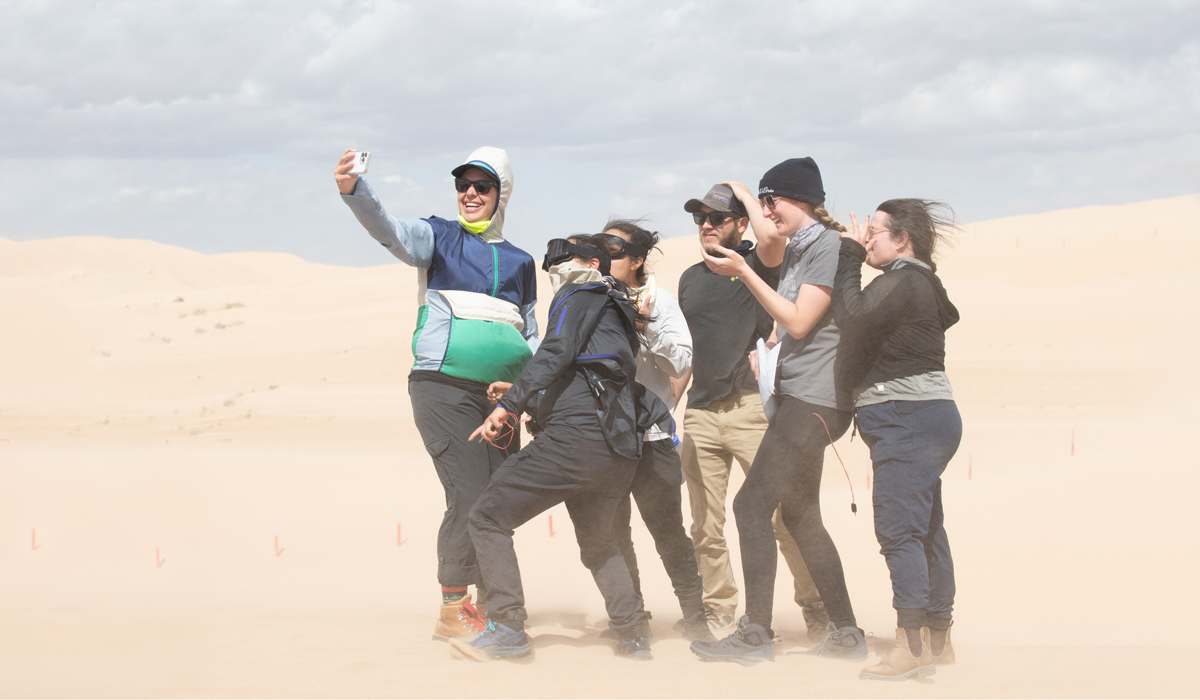
I’m also learning about the women of Team Rivian. We are all very different, but already there are common threads: A willingness to help each other with anything, whether it’s removing a sliver or assembling a tent in a windstorm. Dad jokes. Dietary curiosities. It’s a safe enough space that I share my penchant for eating multiple string cheeses a day, and in return, some of them share their fondness for Uncrustables, pre-made flying saucers of peanut butter and jelly with no crust.
Paired up with Nicole, I find she has a vivid photographic memory, and is the type of learner who prefers to understand new information at the deepest and most detailed level possible. Like the kid who takes apart a toaster to see how it works or the chess player who laps the board, studying each piece both alone and in relationship. The chess board approach to Nicole learning to drive on soft sand initially means a whole lot of getting stuck.
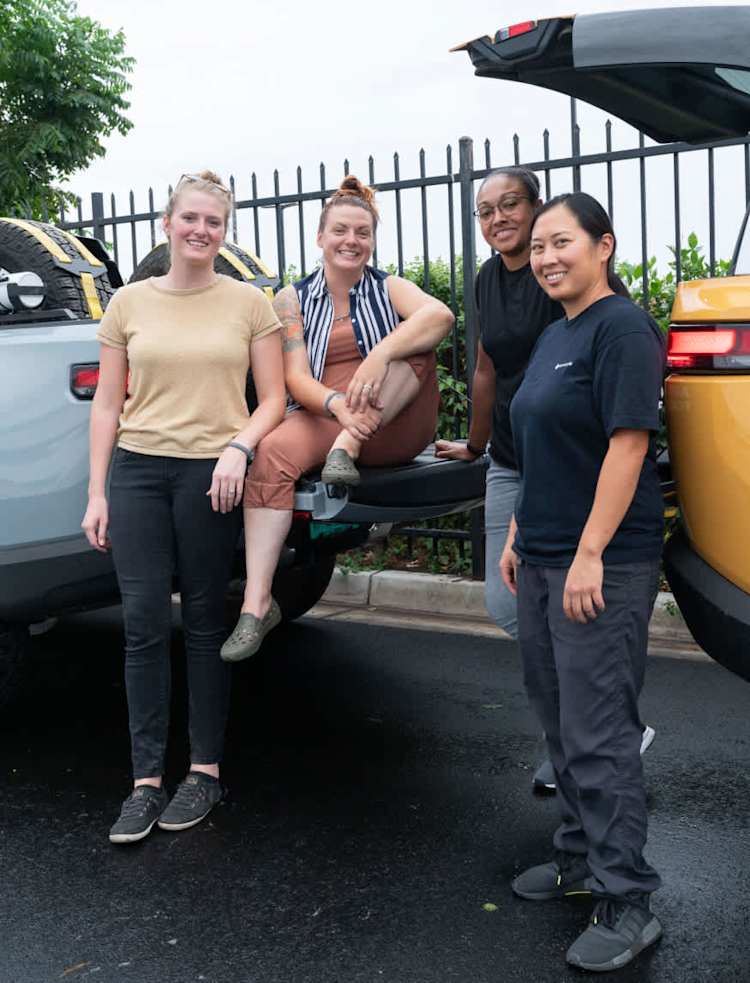
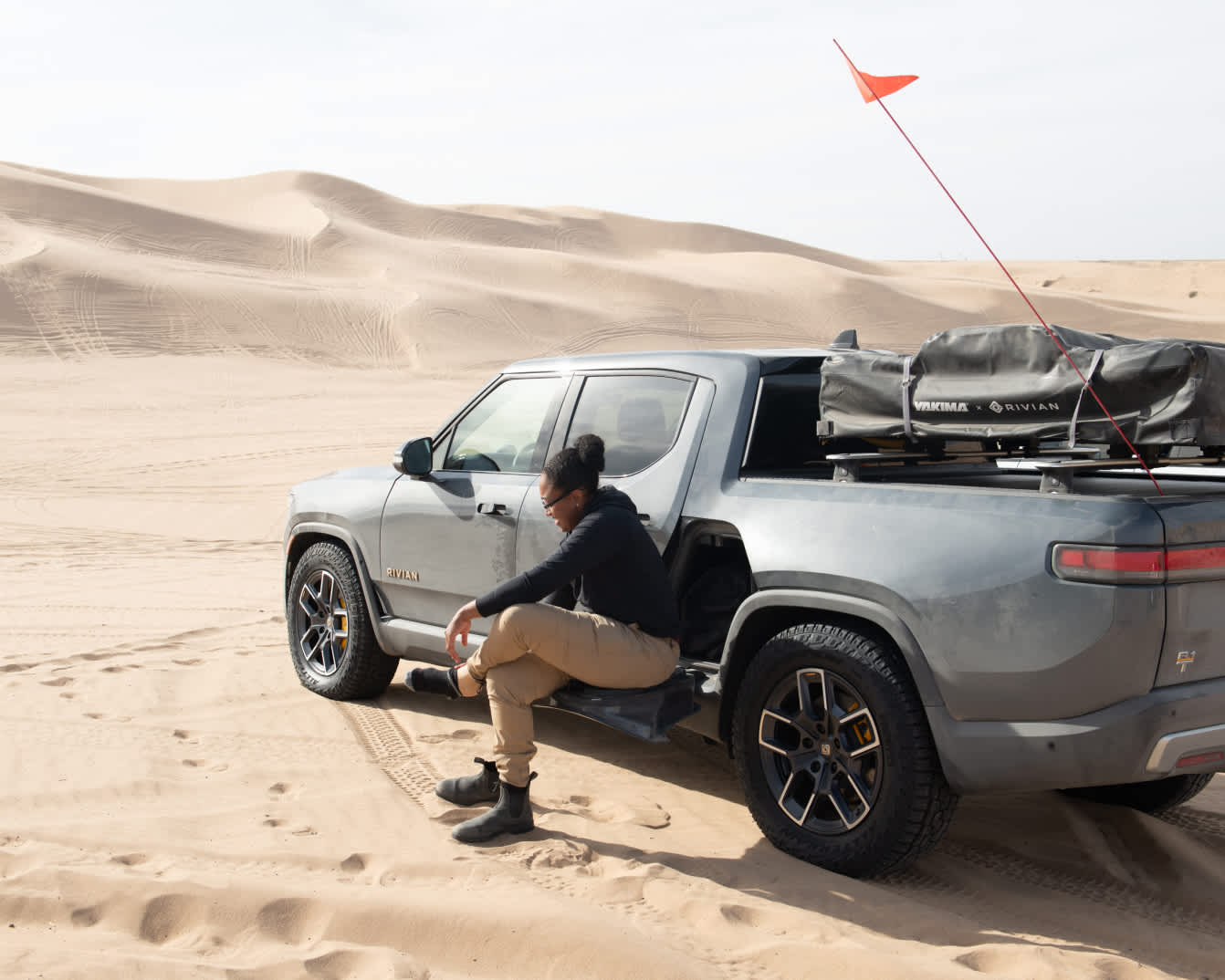
“I need to make mistakes in order to understand the edges of something – in this case, in order to understand my relationship with sand, if you will,” Nicole told me later. “I’m not a surfer or snowboarder, so once I understood that sand is kind of like water’s cousin, I started to get that you really have to flow with sand. You can’t fight against it like with rocks or gravel. Me and sand, we’ve gone from being damn near enemies to – well, now I think we’re in the besties realm.”
Nicole is one of a couple of nurturers on the team, always reminding us to stay hydrated and to keep snacking. Her nickname on the team is “Pop Pop” because, as team manager Ryan Davenport put it, she unleashes so many dad jokes “she must have been someone’s grandpa in another life.” Lucky for us, apart from her deep catalog of groaners, she also has a staggering knowledge of Rivian vehicles, hardware and software alike.
When Nicole was 16, she begged her dad to let her buy a classic sports car. Though he deemed it “held together with spit and glue,” he let her get it on the condition that she figure out how to fix it herself.
“He told me later he meant I needed to get a job so I could pay for it if it needed to be fixed, but I took him literally. I went to the auto parts store and bought some basic tools and bought the auto guide to my car. A couple of months later, the alternator went out, so I fixed it,” Nicole said. “It was the first thing I ever fixed.”
Soon, relatives and neighbors were paying her to change spark plugs and do oil changes. A year later the transmission in her car went out.
“I was foolish enough to think I could do that, too, and in, like, a back alleyway,” she said, laughing. “My uncle Ralph said, ‘You do realize you need a whole bunch of things to replace a transmission, and it’s almost winter. No, just no. So yeah, I ended up paying for that, but I also ended up attending automotive school.”
Our rally team is composed almost entirely of engineers and technicians who come from various parts of the automotive industry, but many of them, including Nicole, say until they started at Rivian, they were almost always the only woman in the room or on their teams.
“There are a lot of things that make me want to do this. Ten-year-old me would probably not have seen any of this as a possibility for myself at the time, so I think at the highest level, we’re representing possibility,” Nicole said. “But not just possibility for ourselves. Possibility for people who may not have realized all the things you can do in an EV. And possibility for women. We want to do our very, very best to represent all of them.”
Ocotillo Wells, California
A Tale of Two Norths
My hand shot up from the back row of our makeshift classroom, tables and chairs beneath a massive canopy stretched between palm trees. Emily Miller, founder of the Rebelle Rally, called on me. “Wait, I’m sorry, did you just say there are two norths?”
“Well, yes,” Emily said, laughing.
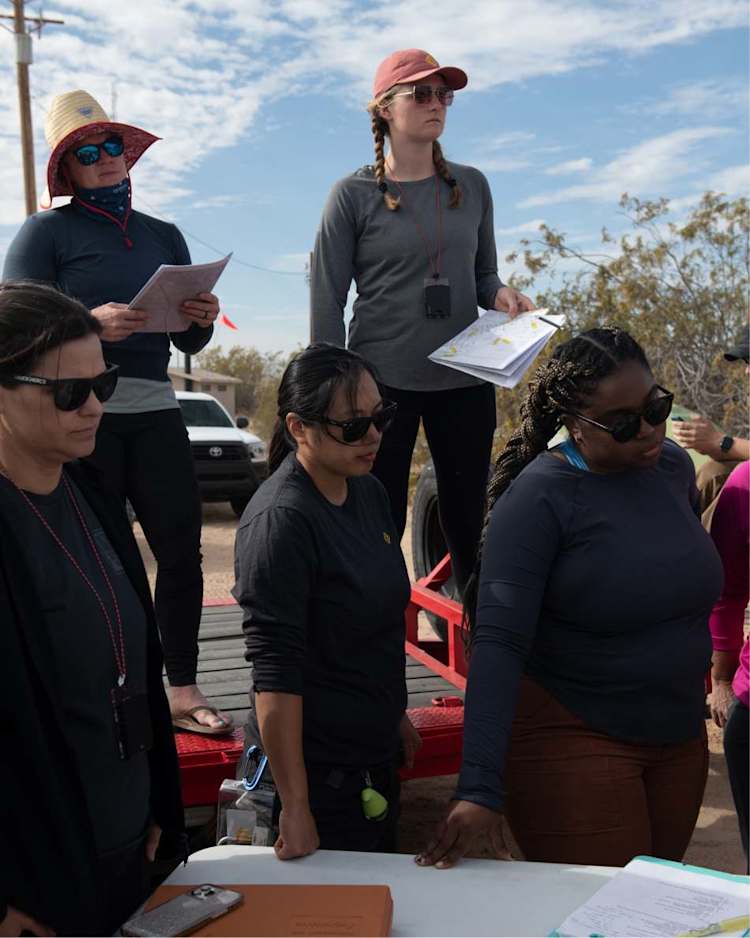
The women of Team Rivian have joined other rally hopefuls and returning competitors alike for a weekend skills class put on by Emily and her team. We’re all camping and eating and learning together at a little palm-lined oasis in the middle of tens of thousands of acres of desert designated for off-road recreation vehicles – perfect for full, immersive days spent plotting points on a map and learning to drive safely over rough terrain to reach those points.
It's only spring, but temperatures are well over 100. Beneath our canopy we are fanning ourselves and taking frequent sips from jugs of electrolyte-spiked water before placing them carefully back onto the table among our piles of notes, maps, compasses, calculators, rulers in every scale, plotters, pencils and highlighters.


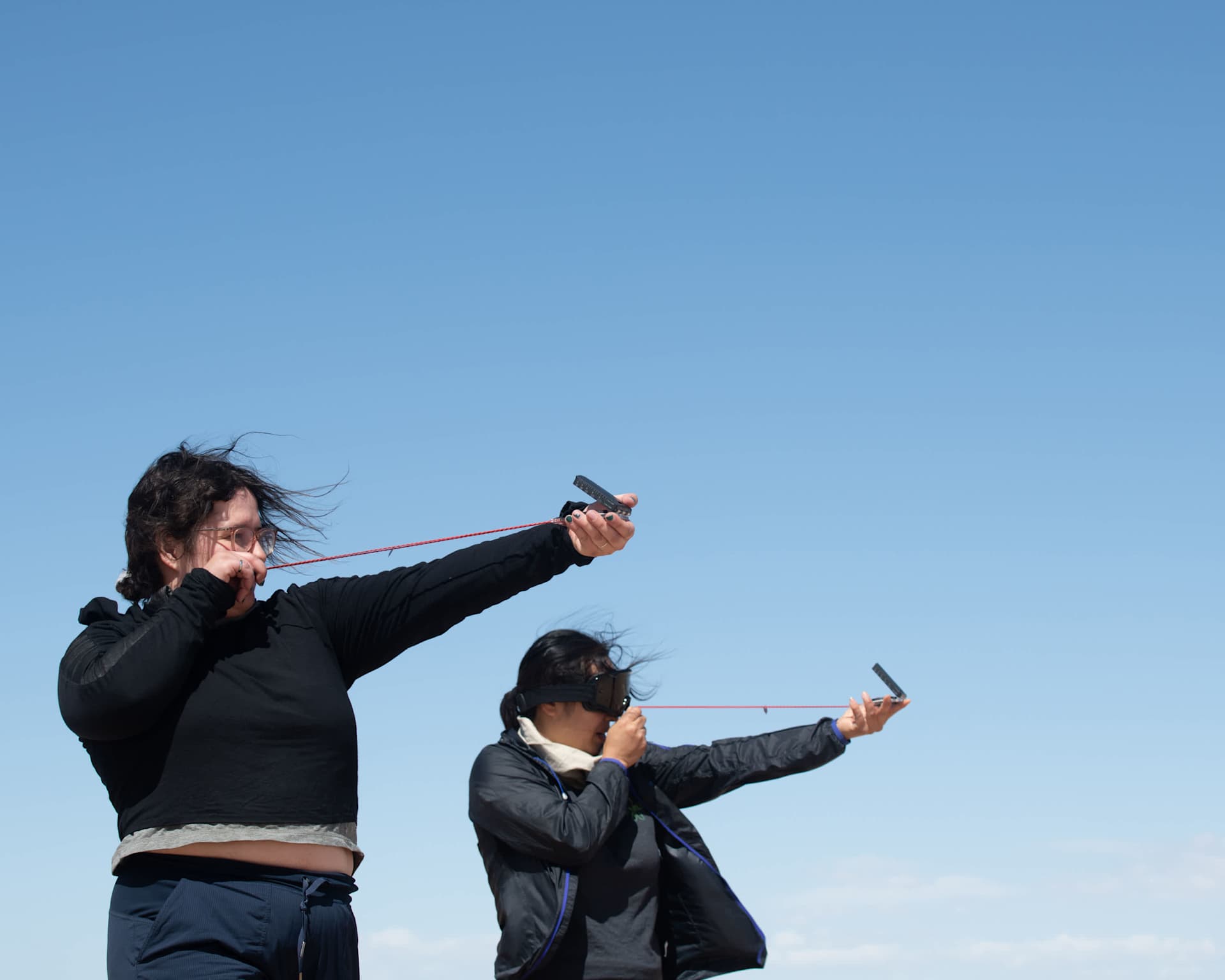
Emily tells the class we could spend all day discussing the intricacies of north(s), but in short: true north is a fixed point on the globe in the Arctic Ocean where latitude and longitude lines meet, while magnetic north fluctuates based on great floating globs of molten iron in the earth’s core.
So there are two norths. How could I have missed this until now? As a lifelong citizen of Earth, I am shook. But if maps point to one north and compasses to another, how can anyone navigate anywhere?
“That’s why we have to declinate our compasses,” whispers Alexandra “Alex” Anderson, a Rivian senior mechanical engineer with whom I'm sharing a table. “Moving them the right amount of degrees accounts for the difference between geographic north and magnetic north so we can navigate accurately.”
The more I get to know Alex, the more I realize she is a lightning quick study at whatever she takes on, whether it’s the mental gymnastics of navigation, the kinetic puzzles of off-road driving or the interpersonal subtleties of teamwork. She is always the first one ready to go out, the first question asker, a consummate note taker, and has seemed entirely at home on this journey since our first moments together, probably because she is. Her love of off-roading began at age 3, when her father gave her a tiny dirt bike, which led to an entire childhood buzzing around the trails near her home in Michigan. When she was a little older, she started tinkering on cars or woodworking projects alongside her dad in the garage.
Her love of engineering soon followed. As a high school freshman, she and her best friend joined the robotics team, though they were dismayed by their initial reception.
“We got, ‘Oh, you should join the media team’ or ‘You should do the arts and crafts and make our t-shirts.’ It was pretty clear they wanted us to do ‘girl things,” Alex said. “But I like engineering. I like CAD design. I like working with machines. It’s what I wanted to do.”
Her mother recognized what was happening and came swiftly to her aid, as did others at the school. Four years later Alex was a mechanical lead on the robotics team, which won the state competition and went on to place sixth overall in the world. During this time she also made a point of visiting elementary schools to show the kids, particularly the girls, her competition robots and introduce them GoldieBlox, science and engineering toys designed to inspire young girls.
“I had never questioned whether or not I could do something, and I hope they never have to,” Alex said. “I wanted them to see that building stuff is really fun and that it can turn into engineering.”
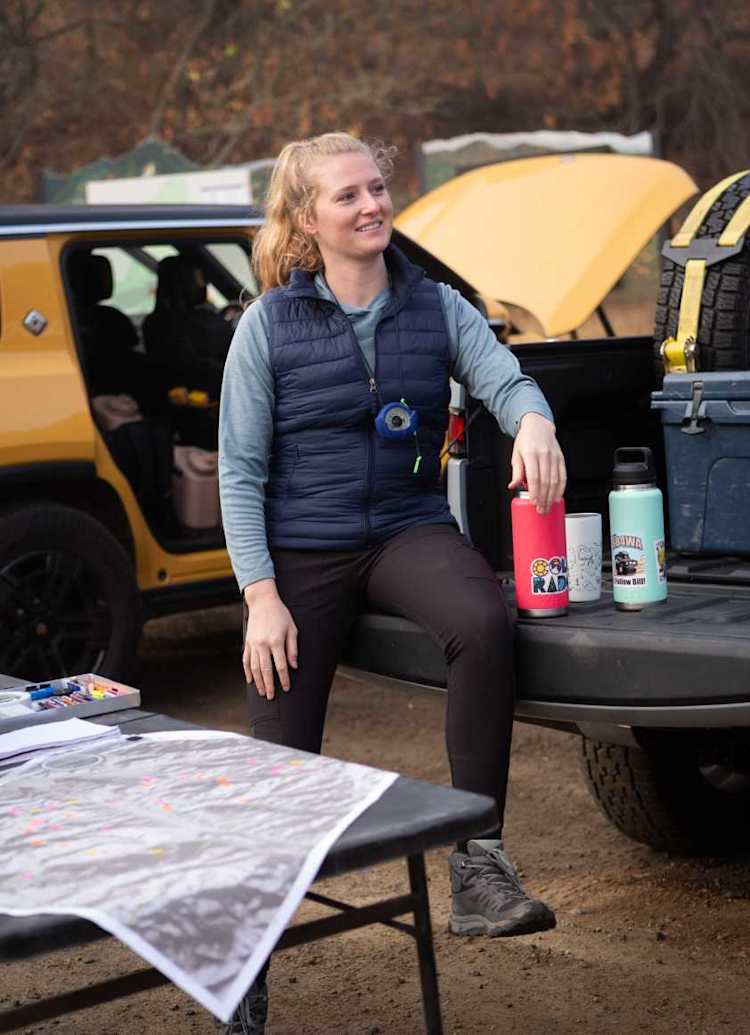
Alex is the team’s vehicle accessory Thomas Edison. At any given moment she is noodling her next invention, designing and engineering something she thinks might make the team or the vehicles more efficient in the competition. This week it was laser-cut wooden map boards with carrying handles. Last week it was a 3D printed storage cube to hold our giant water bottles and organize our navigation tools. She even posed the idea of removing our back seats for the rally and customizing the space to store gear.
“I've really enjoyed making accessories for the vehicle and being able to show all the things passionate customers can do with our vehicles,” Alex said. “That plus getting to represent a company that is investing time, money and effort into women’s off-roading are why I'm very excited to be here.”
The focus of the Rebelle Rally, Emily will tell us again and again throughout the weekend, is not speed. Rebelle is not a race. It is a test of precision navigation and off-road driving skills, all against a backdrop of challenging terrain and circumstances – long days, short nights, wide swings in temperature, sandstorms, potential mechanical difficulties and more.
“Rivian building a team for the first time means it’s women driving the vehicles they helped build, helped design parts for, helped work on, and helped support – and we’re doing so to the extreme, off-road and out in the elements,” Alex says. “We get to show the world what our Rivian R1T and R1S can do, with women from the company behind the wheel plotting the way.”
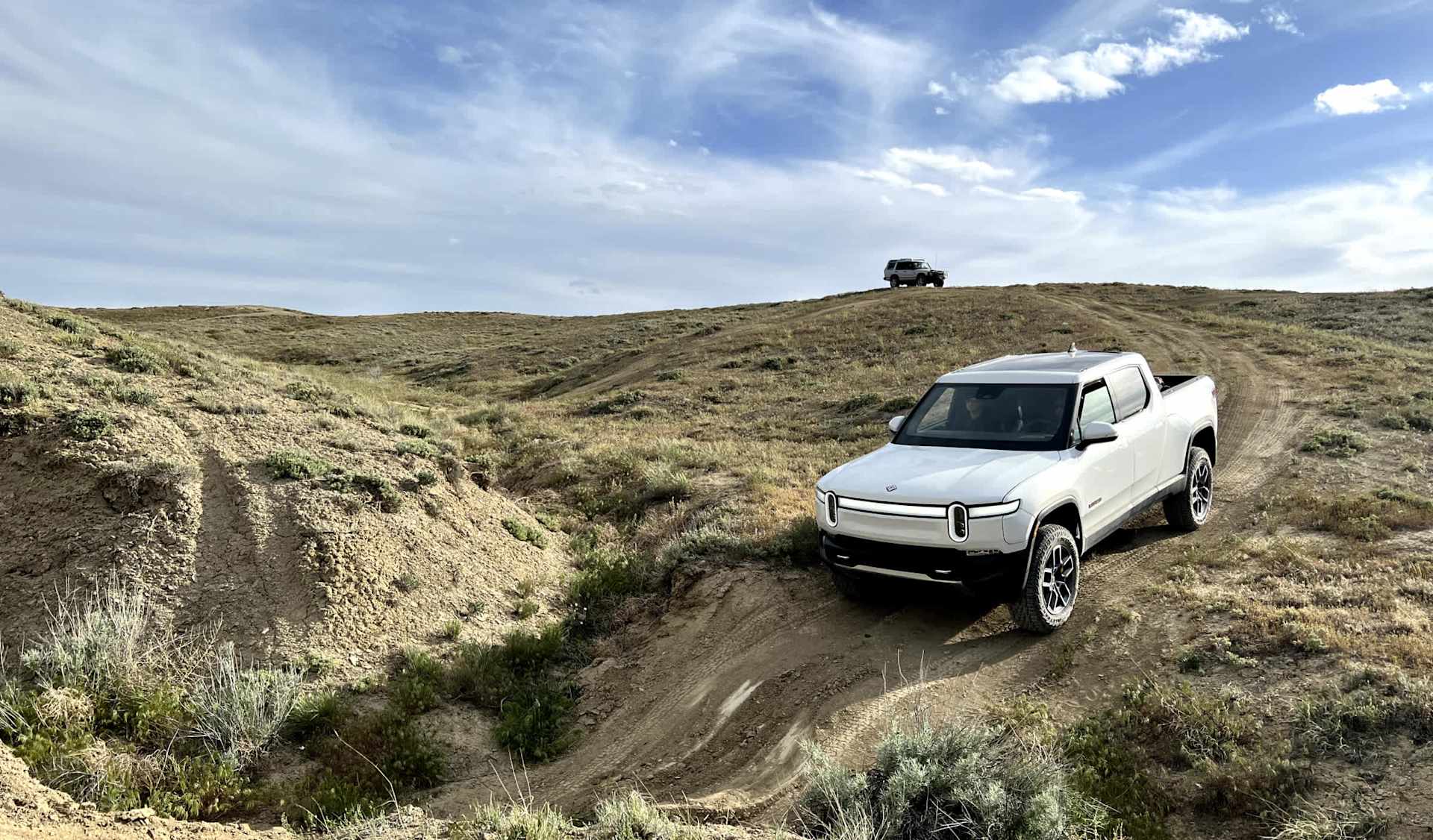
Grand Junction, Colorado
It’s a Hard-Rock Life
“ATTENTION DRIVERS: Steep, narrow, off-camber road. EXPERIENCED 4x4 DRIVERS ONLY.”
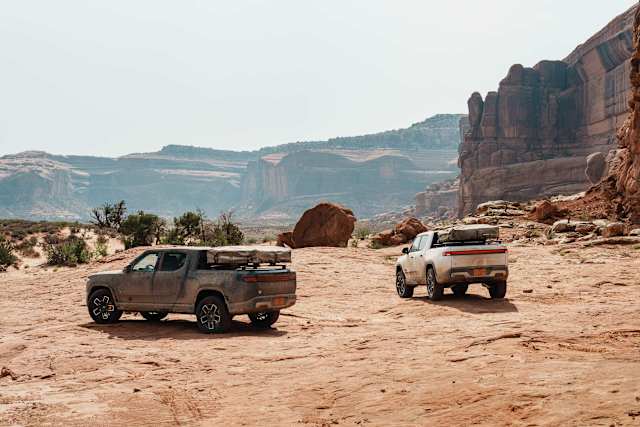
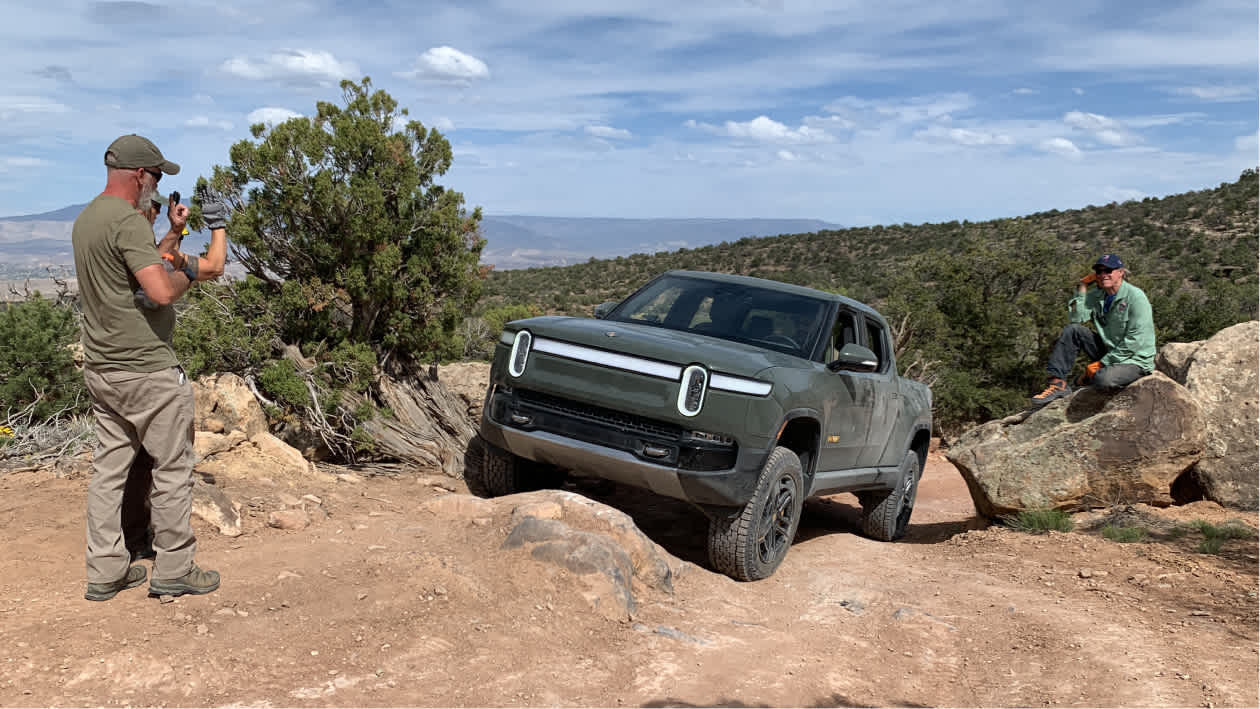
So reads the large warning sign at one end of the Tabeguache Trail outside Grand Junction, Colorado. Our team, in three R1Ts, has just finished piloting a gnarly but gorgeous section of this single-track, off-road trail weaving through canyons, highlands and alongside mesas. Our guide and mentor, legendary off-road instructor Bill Burke, believes we are the first to make this traverse in fully electric vehicles.
“Well done, well done,” he tells us in the parking lot at the end of the trail as we stick the remaining ice from our coolers into our hats and bandannas. “This is known to be a very challenging trail – big rocks, tight trees, big ledges, and you really made a go. You used the traction systems well, the suspension, spotting, stacking rocks – all real-life, serious off-road stuff. You did the whole job.”
Technically, we are in Lilly Macaruso’s back yard. She moved from Oklahoma to Colorado as a teenager and soon after had a formative introduction to the world of off-roading at the start line of The Pikes Peak International Hill Climb, an annual auto race to climb to the top of the 14,115-foot Pikes Peak summit.
“I remember engines starting up and the ground shaking. You're in this beautiful, peaceful landscape and all of a sudden the ground beneath you rumbles and the rocks move and you’re on this massive mountain and even that seems to be trembling from these loud engines,” Lilly said. “I was instantly hooked. This is what I needed to do in life.”
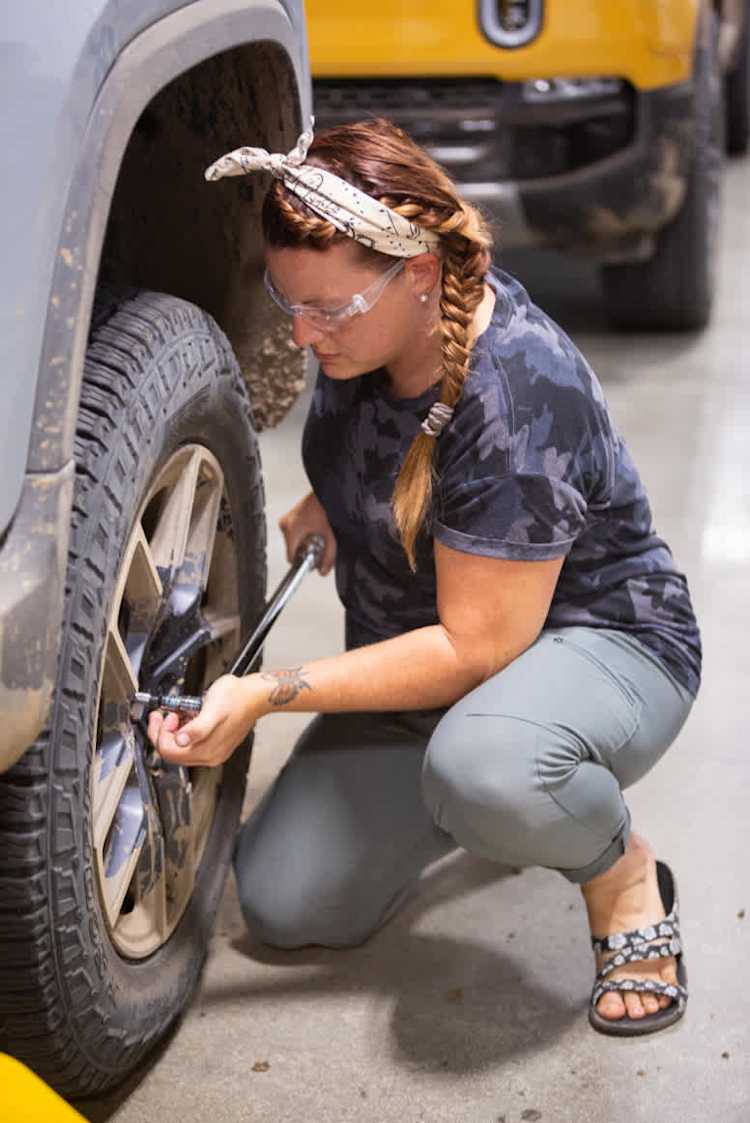
But off-roading would have to be her free time thing because she was determined to become a doctor. As a pre-med student, Lilly sought a job at the auto shop across the street from her college apartment to head off her impending student loan debt. When the owner told her he didn’t need a receptionist, she told him, “Look, I may not know how to change oil or anything yet, but I can do anything a man can do.” He hired her on the spot. A year later, she was rebuilding engines and had changed her major to automotive and racing mechanics.
This is also right about the time Lilly gave a campus tour to a man named Drew Deckman and his son, Phillip. Drew, as it turned out, is a Michelin Star chef who joined the Rebelle Rally in 2016 to be head chef for the annual event. Drew introduced Lilly to the Rebelle Rally and Lilly would eventually go on to marry his son. She later went to work for the rally, leave the auto racing world to join Rivian, and introduce Rivian to the Rebelle Rally. This is all classic Lilly, by the way, she makes things happen. A natural leader, Lilly is comfortable with and capable of surviving and thriving everywhere from the backcountry to the boardroom.
Lilly was the first champion of Rivian’s initial involvement in the Rebelle Rally and the driving force behind this year's efforts to nurture a homegrown rally team. Watching our fledgling crew handle every challenge on Colorado’s Tabeguache Trail was a big moment for her, she said. It had only been a few months, but our capabilities and confidence had come a long way. We were doing it.
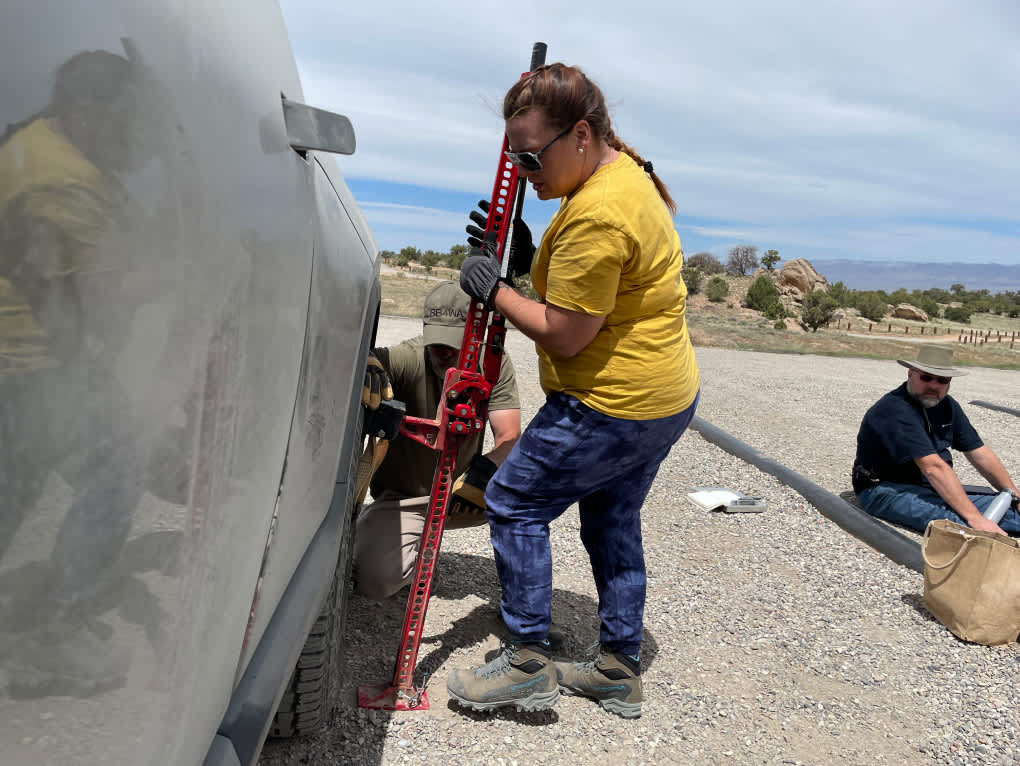

“We are building a team of women whose training and skills will actually come in handy in all kinds of situations well beyond the Rebelle Rally,” Lilly said. “And this mindset of learning, pushing each other, celebrating each other, and making small but meaningful incremental changes that add up over time is how we will build what we have set out to build, both in our lives and as a company.”
She paused, then added, “Hopefully in the process we can help revolutionize how people view vehicles, adventure, the future, and what they want out of life.”
Glamis, California
Turn-by-Turn
It didn’t take long for our team to fall into a morning routine, one that would hold true each time we camped and trained in the desert this year.
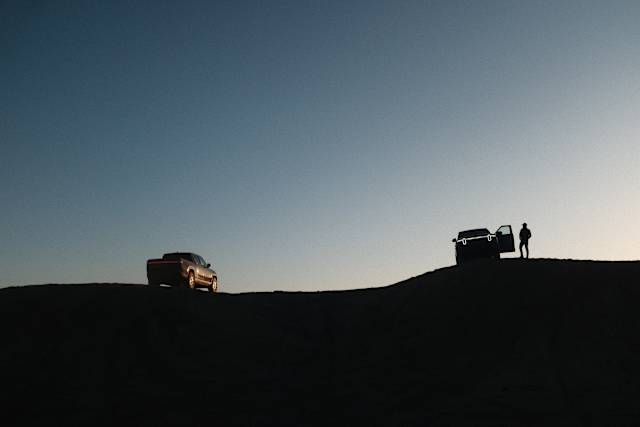
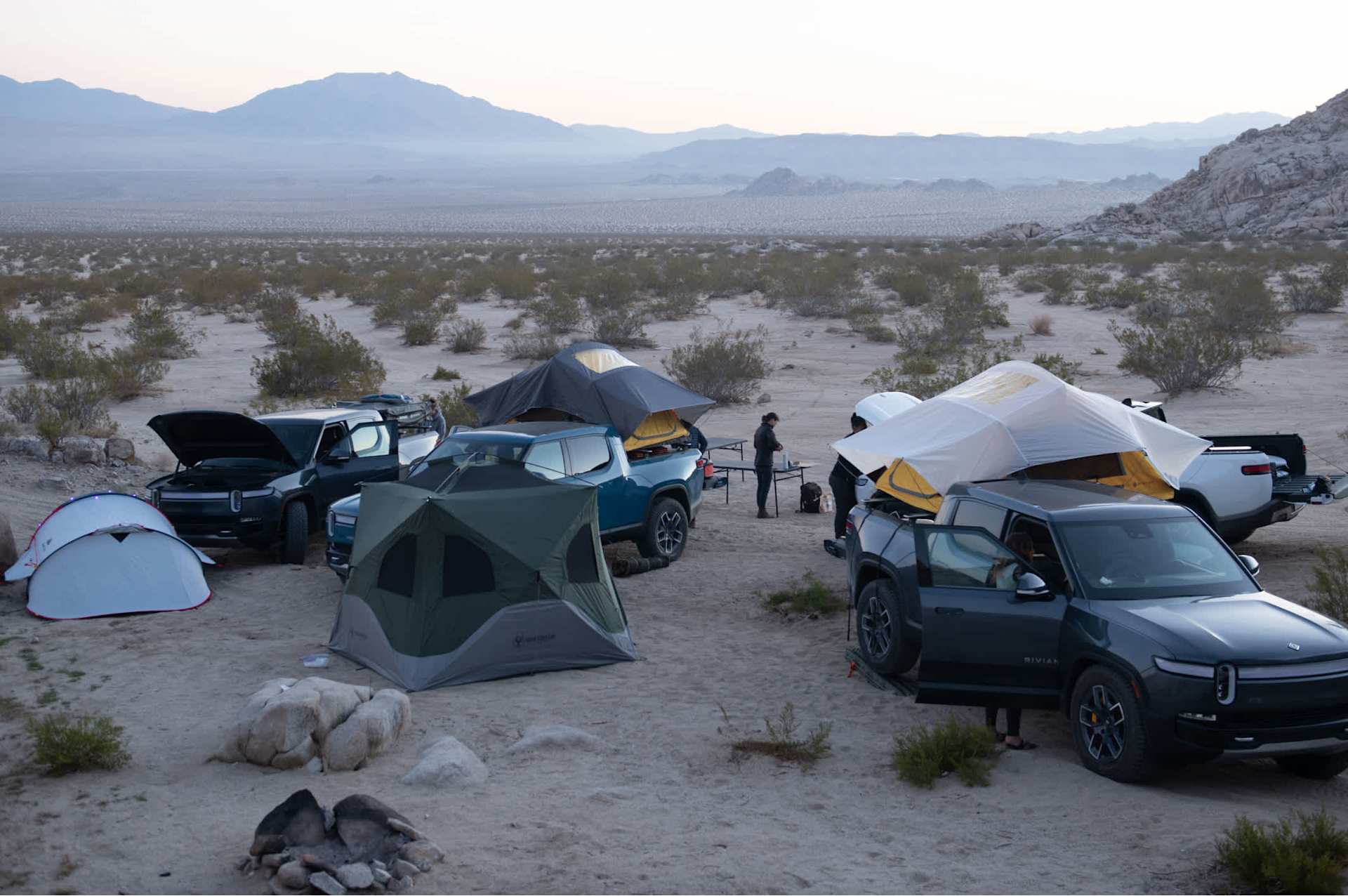
We’re back in Glamis camping on the edge of the dunes. Our tents and R1Ts form a tight circle, which helps protect us from the wind. Some of us set our phone alarms for 6 a.m. Others just wait to hear Nicole’s alarm, the volume and intensity of which feels like an impending nuclear meltdown. We get dressed and pull our large jugs of water onto the tailgates to wash our faces, brush our teeth, and boil for coffee. We eat a quick breakfast – fruit or cereal or oatmeal. Then we pack away our tents and gear and roll out.

As busy and early as these mornings feel, they’re downright serene compared to the mornings at Rebelle. I’m told Emily Miller rings a cow bell each morning at 5, at which point the women (the ones who aren’t already up) hustle to plot new checkpoints on their maps and plan the day’s route through the wilderness.
Each morning we train, I’ve noticed that Ro, is the master of sidling up beside you with the exact thing you need before you’ve even realized you need it – duct tape, your missing water bottle, the air compressor hose, a fresh cup of coffee, an extra set of hands to stuff your tent back into its bag. You’ll turn, and there she is, with her ubiquitous Ray Ban sunglasses and broad, warm smile. “Need help?”

Ro may be quiet, but she is a relentlessly hard worker who can fix or figure out just about anything, which is why I’m excited to be paired with her for today’s training in which we’ll be learning how to do an “enduro.” At certain stages of the Rebelle Rally, teams switch from hunting checkpoints to another kind of challenge, one that tests their ability to follow a timed route using a roadbook with mileages, speeds, symbols and headings. The enduro challenges are fairly polarizing among Rebelle competitors – they strike fear into the hearts of some of the most otherwise ferocious women in the rally, while others think they’re fun. We don’t know yet what we think.
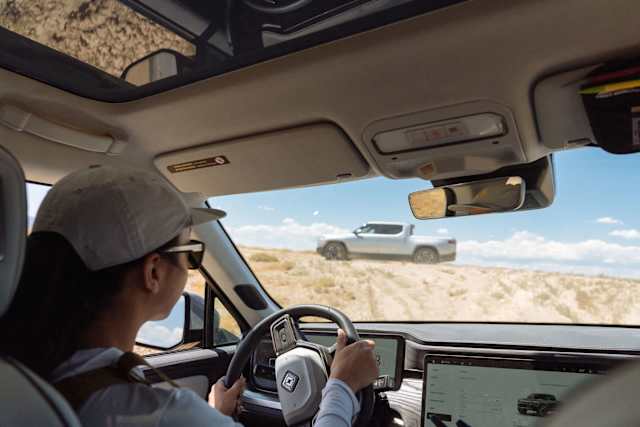
Ro will drive for the first enduro practice, and I will navigate. We’re handed two pages of turn-by-turn navigation instructions, but there are no maps or words – it’s all symbols and arrows and numbers. I’m supposed to direct her using this? My palms start sweating.
“We’ve got this,” Ro says, grinning.
Her unflappability and resourcefulness is hard won. Ro realized she had a knack for fixing cars as a teenager growing up in San Jose, California. She and her friends would keep each other’s cars running, as well as the cars of their friends and family members, happily accepting payment in the form of home-cooked meals.
“I was broke,” Ro said. “I couldn’t afford to pay anyone to fix my car, so I developed my skills out of necessity.”
Starting in automotive school and stretching well into her jobs afterward, people have made the mistake of underestimating Ro. One time it was a female customer who asked that Ro not be the one to fix her car, sometimes it was the male colleagues who second-guessed her abilities – even her physical strength.
“If I need to do something where dudes would use brute strength, I would use physics, leverage, and tenacity instead,” Ro said. “All these years, I’ve learned to just put my head down, work hard, and eventually people realize I know what I’m doing and the respect kind of grows from that.”
When she interviewed at Rivian, Ro was happy to see a woman on the hiring panel, Elyse MacArthur. They swapped stories, and it gave Ro hope that the job at Rivian would be a good path for her. A year and a half later, Elyse and Ro are both with us in the middle of the desert training for the Rebelle Rally.
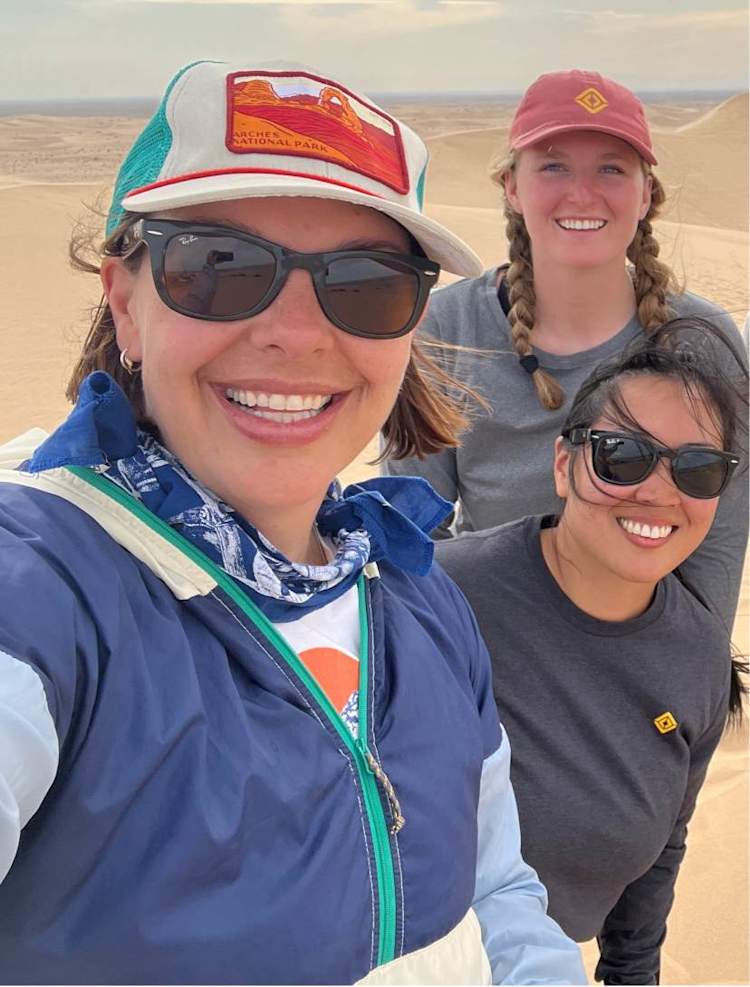
“Except for one time, I've been the only woman tech wherever I worked. It was definitely nice to see there were a lot more women around me,” Ro said. “I'm pretty much working my dream job. Cars and nature and conservation and being out there in the world and experiencing it and helping others experience it also. It really is a culmination of all these different parts of me.”
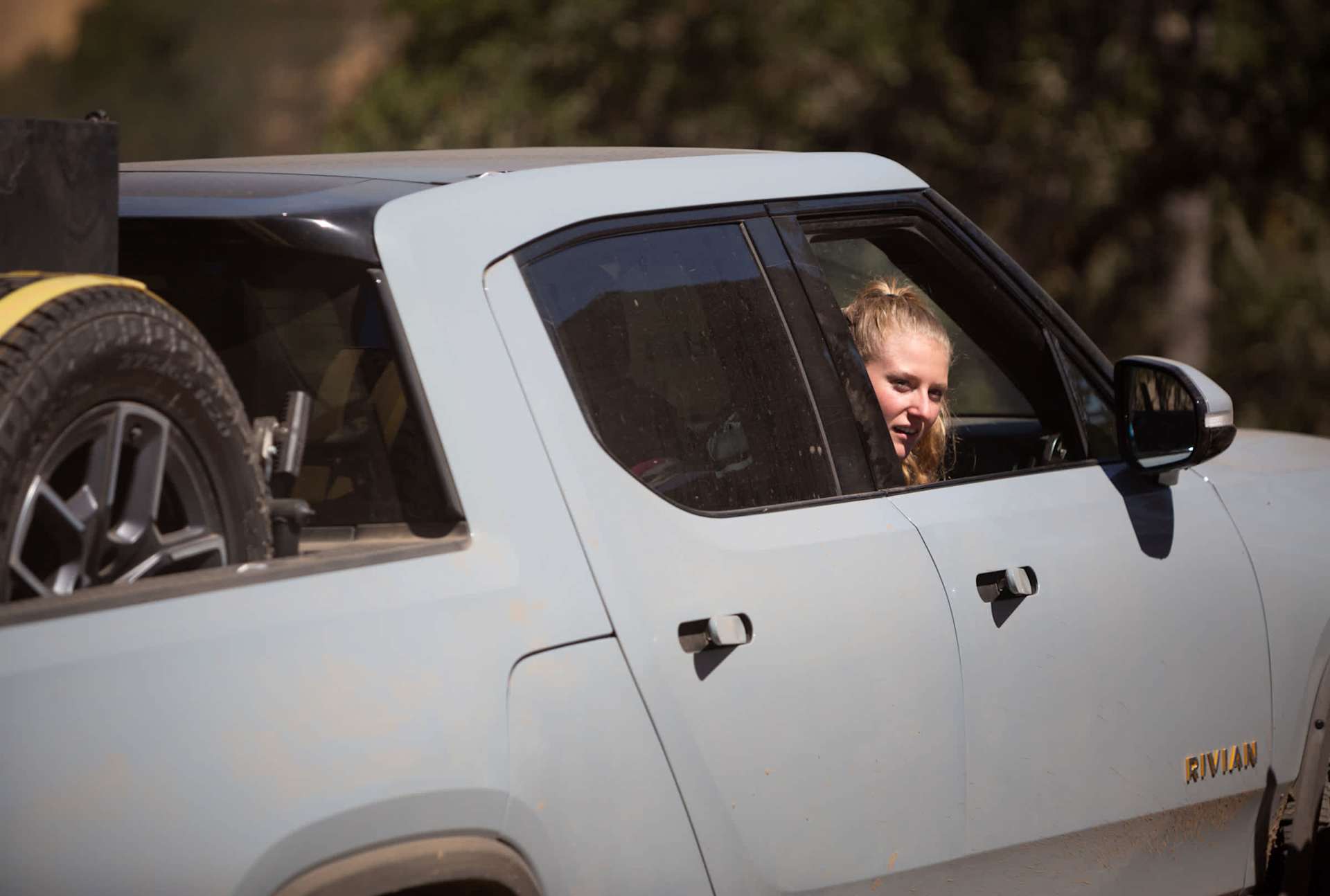
Navigating for Ro in our first attempt at an enduro challenge feels like juggling squirrels. A successful enduro involves keeping close track of distance traveled as well as speed, direction and travel time, all while trying to look for landmarks and avoid making a wrong turn. Still, we finish within five seconds of the goal time – not bad for a first try. When we switch for our second attempt, and Ro navigates while I drive, we finish only one second off.
We cheered and high-fived. “Isn’t it so satisfying when all of this training really starts to come together?” she said.
Irvine, California
Rookies Ready to Rally
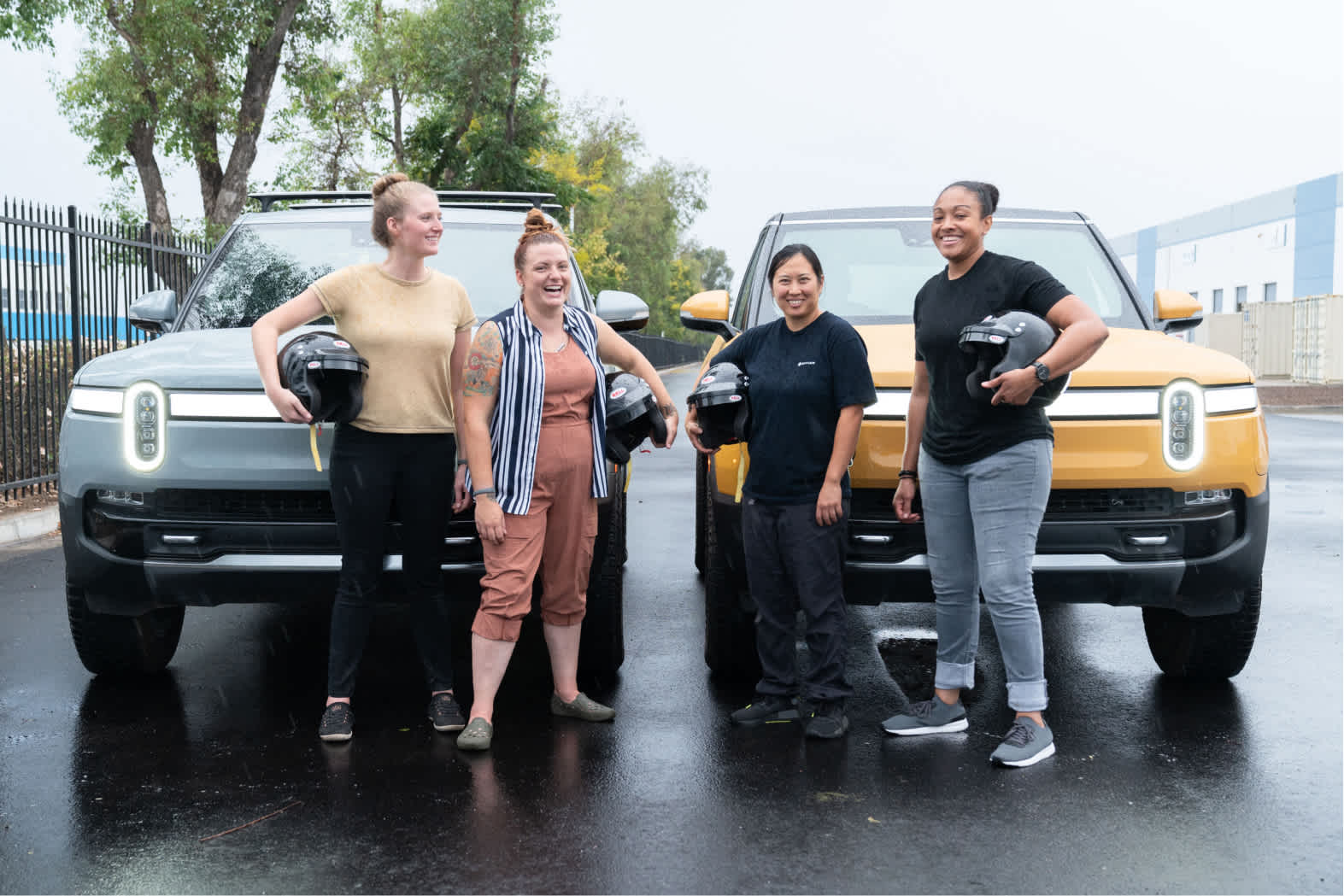
There is a flurry of activity in the two months leading up to the Rebelle Rally. This year, Rivian will enter not just one , but two vehicles in the competition – an R1T and an R1S.
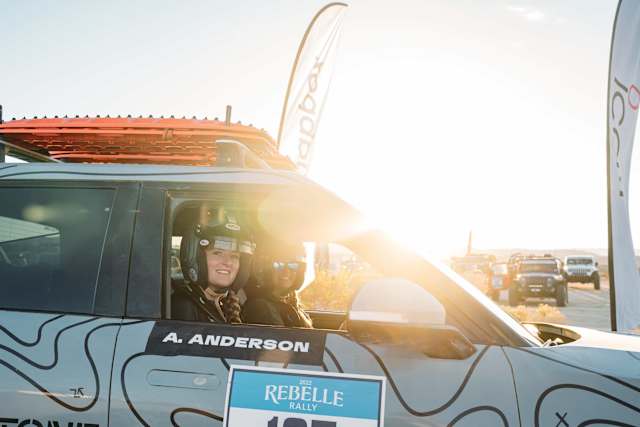
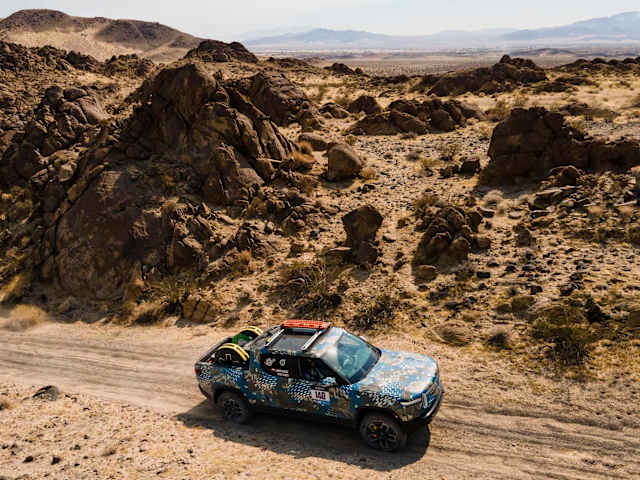
The final competitors are chosen from among our handful of trainees – the truck will be driven by Lilly and navigated by Alex, who have named their team the Limestone Legends as a nod to their paint color. The Compass Yellow SUV will be driven by Nicole and navigated by Ro, who decide to call themselves the Yellow Yetis, an affectionate nod to Gear Guard.
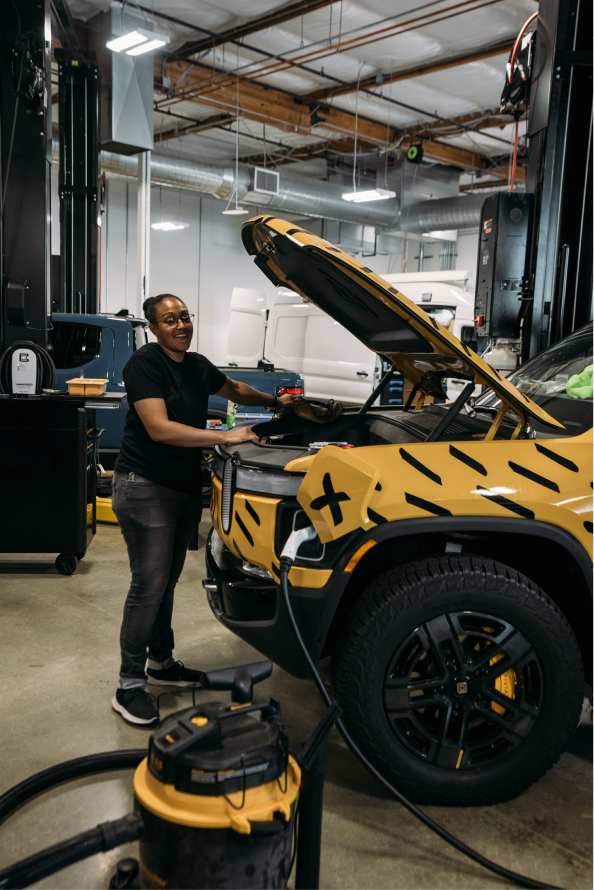
After the two teams are announced, the competitors throw themselves even more deeply into training, this time as dedicated pairs. They log hours and hours of seat time together, sharpening their rally driving and navigation skills and smoothing out any edges in their communication. They are building the shorthand, the routines and the bond that will keep them functioning together on even the toughest days.


“We have a common goal. We want to do our best, we want to have fun, we want to chase checkpoints and not kill each other by the end,” Alex said, laughing. “We want to have a good time. I would rather have a good time than win, because we know that we're going to go further in life together than just this one rally.”
I will still get the best seats yet for a Rebelle Rally, an event that played such a big role in drawing me to Rivian, and that continues to inspire me. The rest of Team Rivian, minus our four intrepid competitors, will work behind the scenes at the rally to support all the women of Rebelle. We will cheer them on as they drive out each morning, and welcome their dusty, tired faces home each evening.
Eight months after I started training for the rally, an entire category of skills and situations that once felt intimidating I now consider fun. Rock crawling, dune driving, high jacks, tow straps, MAXTRAX, compasses, plotters, maps – throw me some back-country coordinates, a map and compass and a string cheese, and there’s a good chance I can plot our way there.

Ro brought up a good point when we were talking recently, one I’ve heard Emily Miller discuss as one of the reasons she started the Rebelle Rally. These vehicles that sit in our driveways and get us to work and the grocery store and to visit friends and family are capable of taking us to so many more places than we could imagine. A few navigation and off-road skills can unlock so much.
“We’re doing this rally, and we’re doing it in a stock car,” Ro said. “And we’re going to try to navigate safely through these challenges and then drive it all the way home after the rally to show people you don’t need a trophy truck to get out there and enjoy the wild. Because the more people who can get out there, the more people will care about taking care of it, and the better off the world will be.”
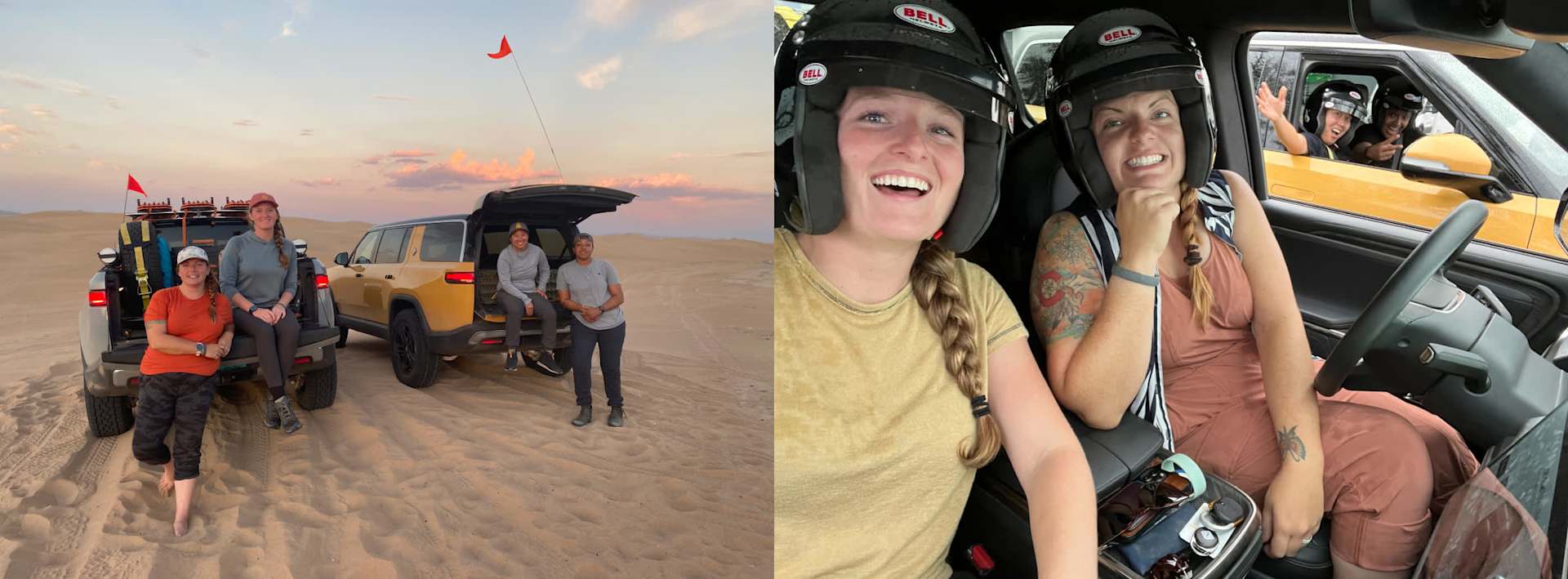
About the author: Jennifer Warnick has gotten the last of the sand from Rebelle trainings out of her hair, but not her boots. She lives in the Pacific Northwest and leads storytelling at Rivian.
Trained drivers. Captured in off-road areas designated for this type of driving. Be responsible. Drive safely.