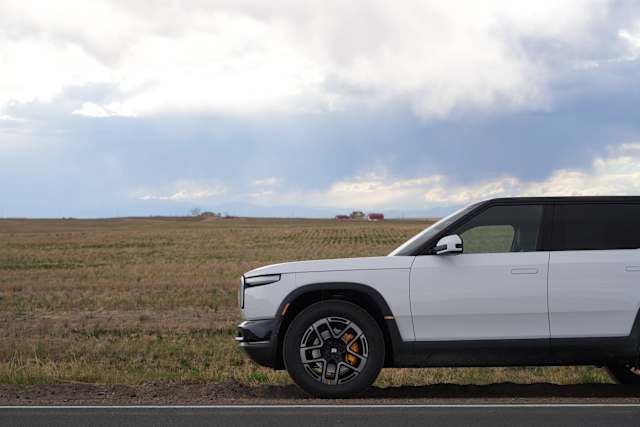
On a cool, breezy March afternoon in 2021, six members of our team gathered in a Southern California parking lot for an unusual design review.
Officially, they were there to choose the sound our vehicles would make at low speeds to alert pedestrians and cyclists to its otherwise silent presence. But that day, everyone there understood they were doing something more: They were giving Rivian’s first truck and SUV a voice and the beginnings of an audio language.
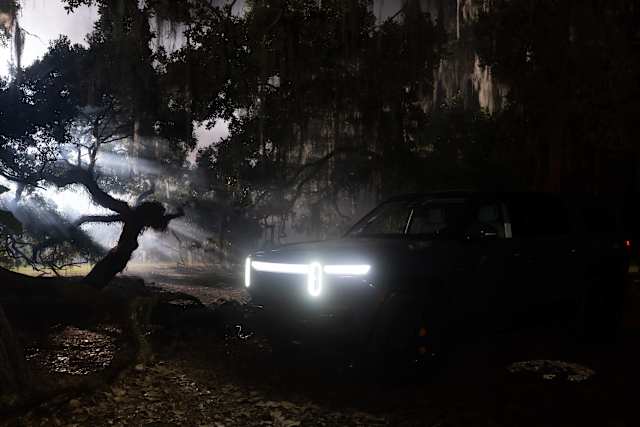
The group slowly circled the parked R1T as the first of three finalists for the Rivian AVAS sound — whittled down from more than 50 options — began to play from a stationary R1T.
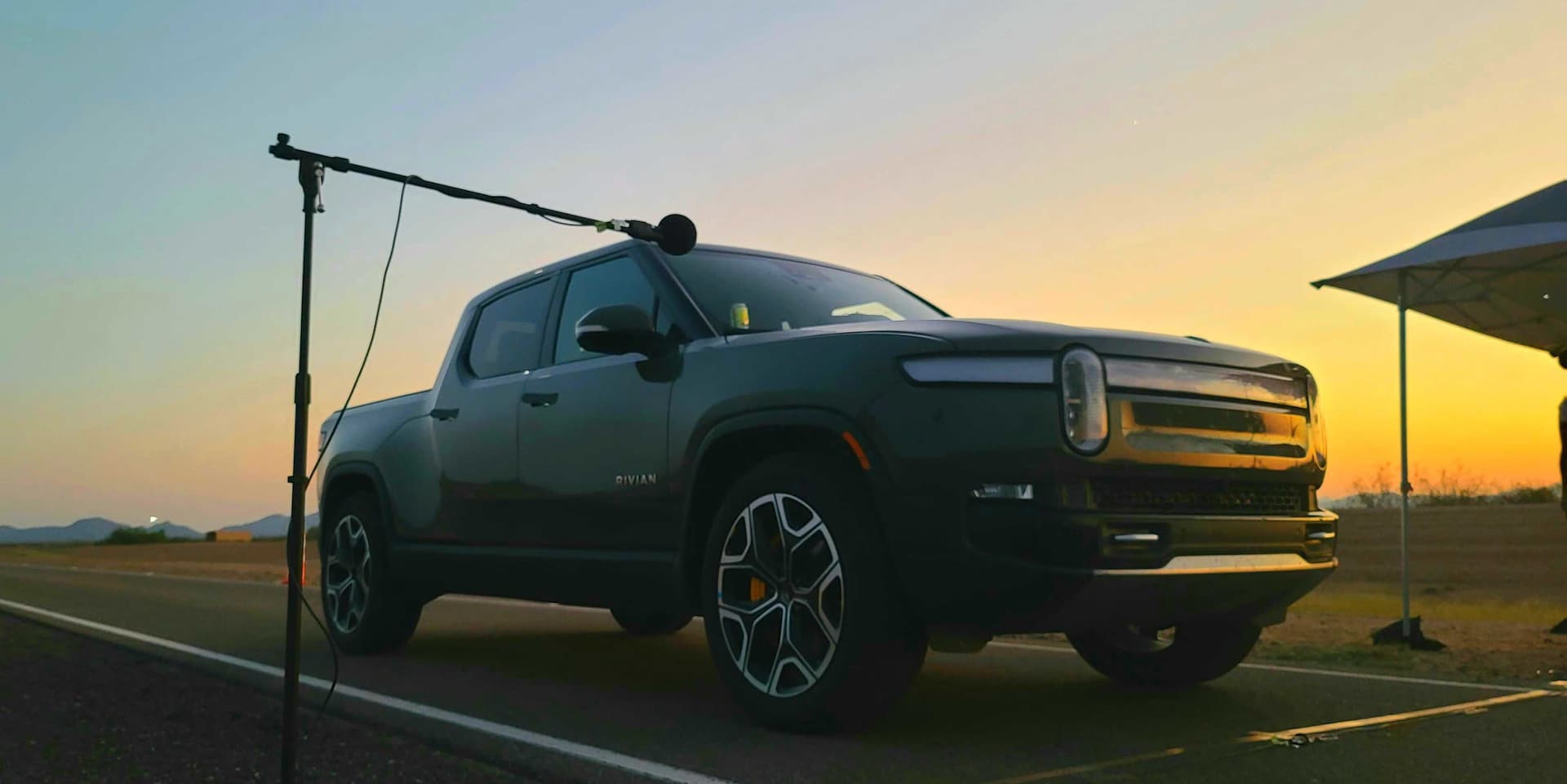
Of all the sounds we created for our vehicles, the acoustic vehicle alert system, or AVAS, was one of the most debated and considered. We knew this would be something owners and non-owners alike would hear a lot — in grocery store parking lots, out on trails, campsites, and at busy city intersections.
Erik G. Principal UX Designer
The group repeated this listening exercise in a quieter garage and once more with the R1T slowly driving past the group, and a winner emerged. It was a sound that paradoxically managed to both stand out and blend in to almost any environment — one that would safely let people know a Rivian was approaching, yet wouldn’t disrupt the tranquility of a remote forest road.
It was the sound of wind and water.
The Nature of Sound
For more than a century, the primary sound automobiles make has been inextricably linked to their main source of propulsion: the internal combustion engine. Over the years, exhaust system innovations and new materials have allowed auto makers to fine-tune and modify engine noises, but it’s always been a sonic reshaping, never a wholesale reinvention.
Electric vehicles changed all that. Like other EVs, the R1T and R1S are inherently quiet, producing little-to-no sound from their electromagnetic motors. It’s a benefit that’s hard to fully appreciate until driving one. Still, in a world where traffic noise remains a major source of environmental pollution, mass adoption of EVs has the potential to alter the soundscapes of our cities, neighborhoods and outdoor spaces in profound ways.
This sonic shift was front of mind for Rivian designers and engineers as they went about designing an audio ecosystem for our vehicles. In the same way the R1T and R1S presented an opportunity to rethink what a truck or SUV could be and do, they also offered a blank acoustic canvas for how our vehicles might better communicate information, both to drivers and passengers, and to the world around them.
We knew from the beginning we wanted to use nature as a source of inspiration for all the sounds we incorporated into the vehicles. If electric vehicles are the future of transportation, why not make them blend into the natural world they’re helping to preserve?
Chris J. Director of UX Special Projects


To help build this portfolio of nature-inspired sounds, Rivian partnered with the sound design firm Audio UXOpens in new tab. “From the beginning, it was clear that everything we were trying to accomplish was in service of one core idea: preserving the natural world for future generations,” says Dexter Garcia, co-founder and chief strategy officer at Audio UX.
They started by thinking about the R1T and R1S as if they were actually a part of the natural ecosystem. If that were true, what would their voice be? If they could breathe and talk, what would that sound like?
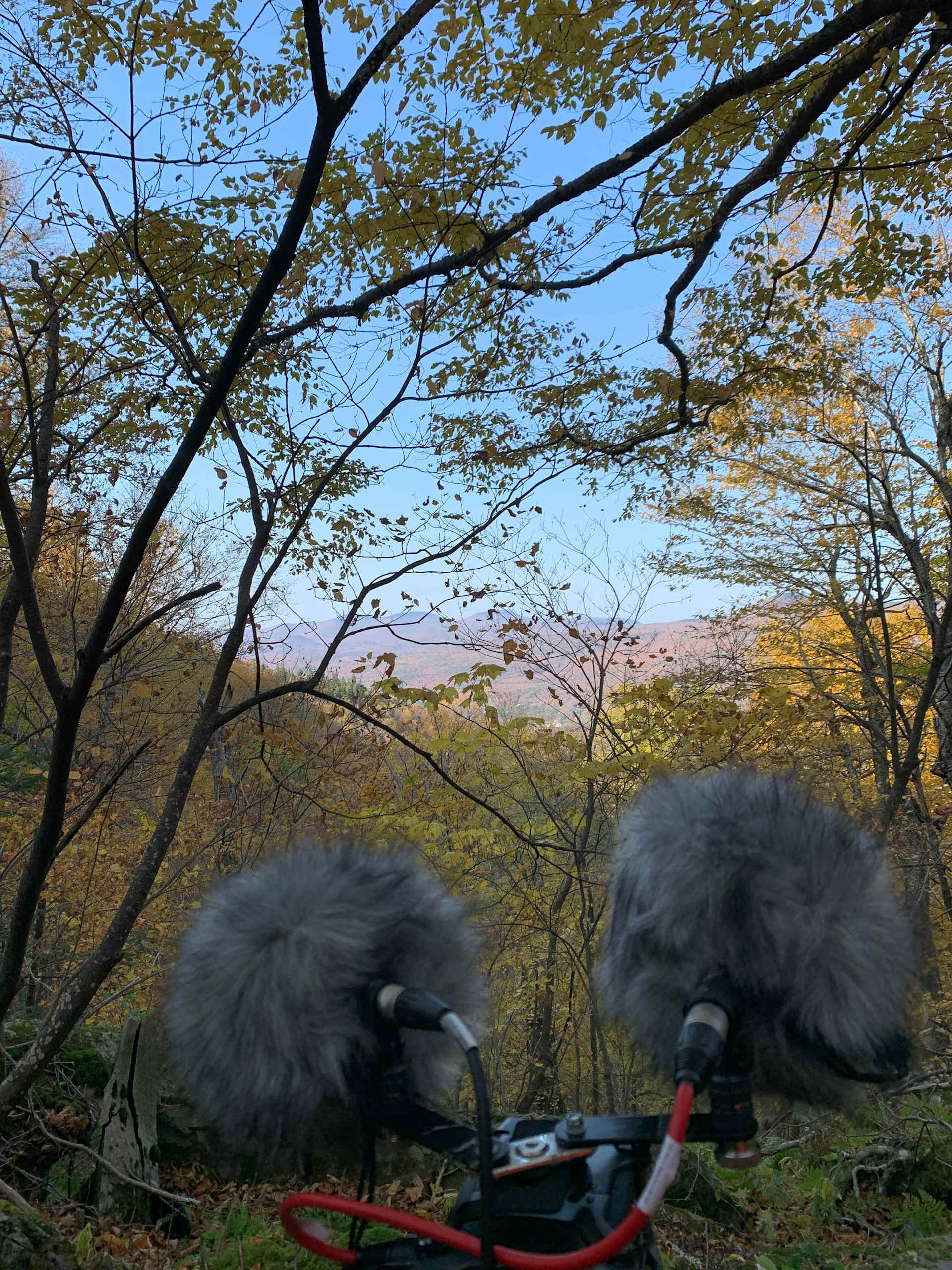
To begin answering those questions, the team turned first to specific sounds from the natural world, recording everything from animal calls and thunderstorms to acoustic instruments and human voices. Those starting points provided a basic sonic framework for the way Rivian vehicles would ultimately communicate. But they were only the beginning.


“By synthesizing these sound samples into entirely new instruments, we created a richly layered audio aesthetic.”
Eric S. Chief Experience Officer, Audio UX
R1T Bird Calls
During the summer months, the chirps and warbles of mountain bluebirds can be heard in open habitats across much of western North America. As more and more Rivians are delivered all over the country, a version of those sounds will join them.
Every time you lock your R1T or R1S, the vehicle emits an enthusiastic double chirp that’s instantly recognizable as a bird call. That bird happens to be the cerulean blue migratory thrush known as the mountain bluebird. Like the other natural sounds incorporated into Rivian vehicles, it’s not a simple sonic cut-and-paste job, but rather an altered version of a real mountain bluebird call.
Traditionally, automotive lock sounds have used the physical car horn or alarm system chirp as a confirmation the car has been locked and is armed. Either way, it’s almost always disruptive to the surrounding environment.
As an alternative, the teams focused on creating a sound that could give the same audible confirmation, minus the unnecessary noise pollution. Almost immediately, they landed on birdcalls.
The frequencies of bird chirps happen to sit in the most sensitive hearing range of the human ear, which makes them a prime candidate for an easily understood sound source. What’s more, higher-frequency chirps are also easier for humans to directionally locate, while still naturally blending into the surroundings, an added benefit if, say, you forget where you parked your Rivian in a crowded garage.
“The lock chirp really sums up everything we're trying to achieve. It’s natural, fun and delightful.”
Aaron L. Director of Noise, Vibration and Harshness

Fine-tuning
Sound-producing animals and insects in an ecosystem — whether it’s Yosemite National Park or the forests of Borneo — often find their own unique frequencies to more effectively communicate with each other without overlapping with other species.
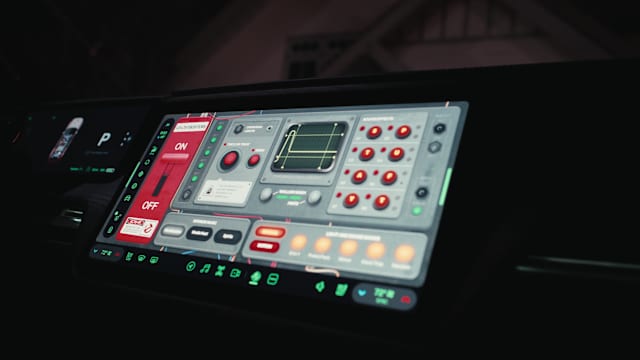
The team used this idea, sometimes referred to as soundscape ecology, as a framework for creating the myriad sounds drivers and passengers hear inside the vehicles. Infotainment, navigation, charging, Driver+ and even the Camp Speaker — each of these categories presented an opportunity to use sound to communicate clearly and efficiently with Rivian owners.

It’s like a natural tuning happens, where all the animals adapt both to the noises of the surrounding environment and also to each other.
Dexter G. Co-Founder and Chief Strategy Officer, Audio UX
For affirming moments, like the confirmation sound the vehicles make when you touch your key card to the inside of the driver door panel to begin driving, the team used warm, woody cello plucks to create a feeling of approachability and combined them with recordings of smooth pebbles to evoke a sense of security.
Alternatively, navigation-related chimes and alerts lean more heavily on animal sound sources — specifically animals that happen to be highly skilled travelers. To alert drivers to an upcoming turn, we started with the great horned owl call as the base to give the sound depth, then sped it up and added high-end reverberations to cut through and calmly grab the driver’s attention.
Finally, for urgent, safety-related sounds, like our rear cross-traffic detection warning, the teams used a dissonant chord with a rapidly repeating single note at the end to cut through ambient noise and immediately alert the driver.
“Ultimately, these families of sound throughout the vehicle feel coherent and recognizable, but also just kind of disappear into the experience of driving your Rivian.”
Dexter G. Co-Founder and Chief Strategy Officer, Audio UX
SIGNAL FROM NOISE
While the Rivian lock chirp is a playful, more environmentally friendly version of an alarm-system-based lock chirp, our turn signal sound represents a complete reimagining.
The rhythmic, two-step clicks typically used are actually based on the sound of a relay circuit opening and closing as current passes through on its way to the turn signal lights. That technology dates back to the late 1930s and ‘40s. Even though most modern vehicles have long since abandoned the physical thermal and electronic flashers that produced these sounds, car manufacturers have kept the clicking sounds alive by creating artificial versions and feeding them through the vehicle’s audio system.
Today, there are some vehicle sounds that really have no compelling reason to exist other than that they’ve always just been there.
Erik G. Principal UX Designer
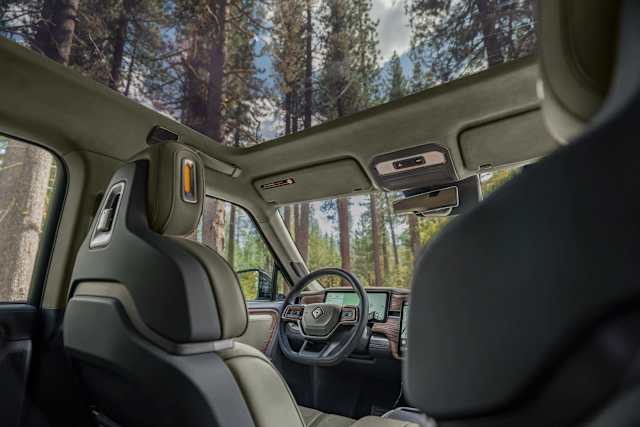
When it came time to reconsider the turn signal audio, the teams opted for a single sound synchronized with the light instead of two individual clicks for the on and off states. The idea was to create something concise and pleasing to the ear, says Garcia, especially given how often drivers and passengers would hear the sound. A succinct, tree stump-like thump ultimately became a favorite. Not only was there harmony between the warm, organic sound and the wood trim inside the R1T and R1S, the new turn signal audio also fulfilled its main purpose in a pleasing way.

Right Noise Machine
If you had eavesdropped on that parking lot gathering back in March of 2021, the winning candidate may have initially sounded a lot like, well, noise — specifically, broadband noise.
Examples of broadband noise in nature include rainfall, waterfalls and ocean waves, and while it can have many sources, broadband shares an ability to mask other, more annoying sounds in the surrounding environment. While not an obvious choice for an AVAS sound, broadband offered a unique way to achieve minimal environmental impact while still alerting people to the presence of the R1.
The teams eventually settled on a kind of mash-up of broadband noise that felt natural and unobtrusive in virtually every environment they tested it — garages, forest trails, city streets and parking lots. Created by blending real-world recordings of wind and water from Mammoth Lakes, Laguna Beach and the Colorado River, the final piece of audio had a sonic profile that worked equally well in urban areas and off-road destinations.
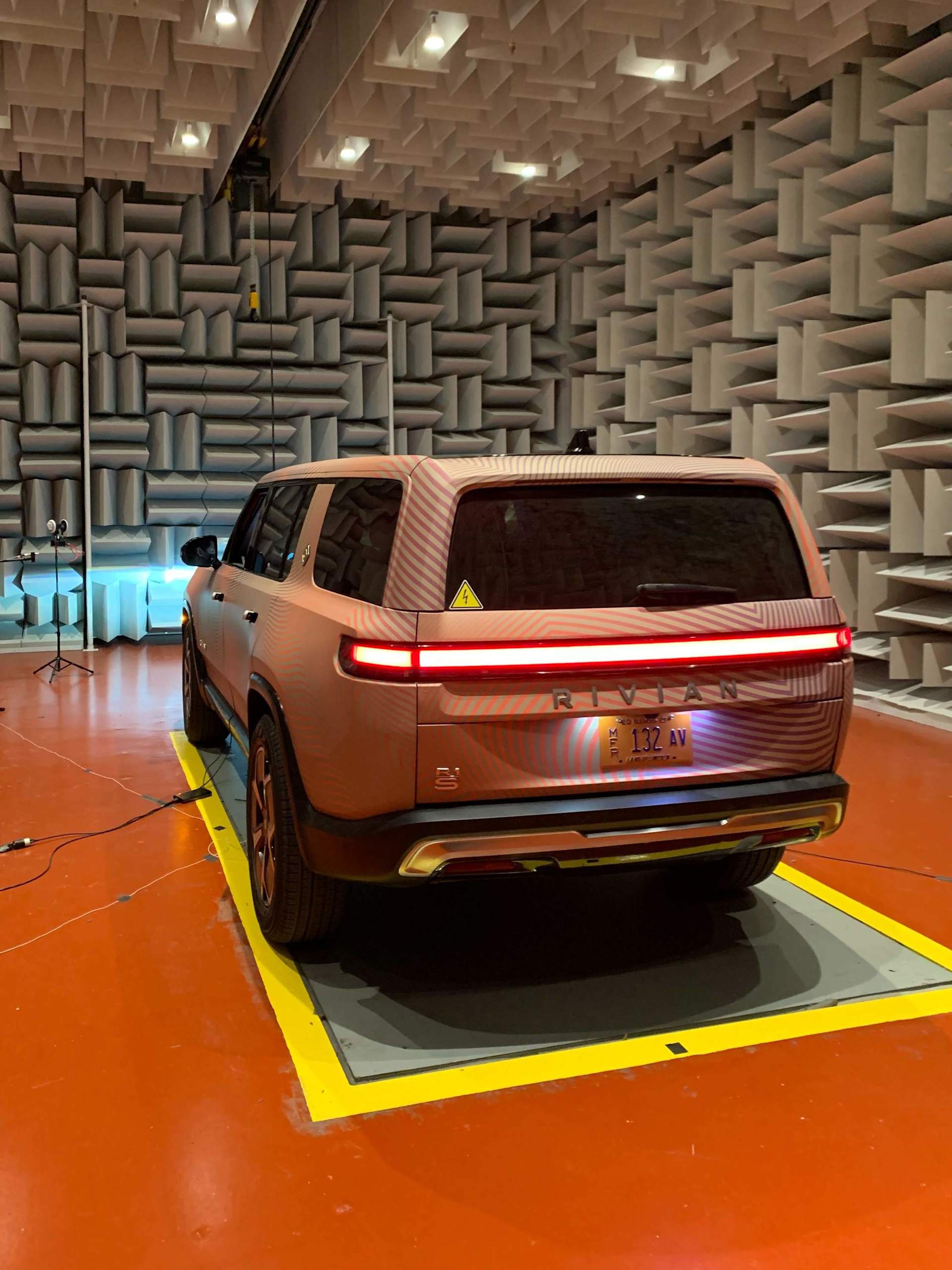

As much as it can inform, delight and profoundly shape the EV driving experience, good automotive sound design is also about knowing when not to use audio feedback. Overdo the in-vehicle audio chimes and you can easily end up with a cacophony of beeps and dings that stress drivers out or confuse them.
That’s why of the more than 900 distinct sounds created for the R1, only about 40 eventually made it into the vehicles. "Ultimately, it’s a subjective call, but our goal was always to be extremely intentional about our vehicle sounds and not detract from what remains one of the more compelling reasons to drive an R1T or R1S: they’re quiet," says Lock.
“Our goal was to be extremely intentional about our vehicle sounds and not detract from what remains one of the more compelling reasons to drive an R1T or R1S: they’re quiet.”
Aaron L. Director of Noise, Vibration and Harshness
Take your Rivian down a winding coastal highway or through a curvy wooded backroad and you might agree: Sometimes the most satisfying sounds are the ones right outside your window.